http://dbd.game/killswitch
Damn playing a low tier killer is Horrible right now.
Comments
-
Look at all of my arguments, they are all focused on trying to convince you that solo players are better and more efficient than you claim.
Which was the problem. I’ve told you countless times that this was never about whether solo players could play efficiently or not. It was about the level of efficiency and coordination that differs between the two. You just can’t seem to understand that because that would require stepping into a realm of play you don’t have experience in, so you feel safer arguing whether they can play efficiently or not, ignoring the actual argument.
It's not an assumption when you stated you swf, brought up ghoul, and have top500Spiderman as a username.
Saying that I play in 4 man and ghoul being mentioned doesnt = You play swf and ghoul, you play the game on easy mode. Iv played/play everything.
That comes from a lot of solo experience, I am relying on that experience to make these arguments.
Again, this was never about wether solo players could play efficiently or not. I encourage you to go back and revisit my replies to you. But this time read and make sure you read with an open mind.
I think the funniest thing about this whole argument is that in most other threads I would be applauded for saying that solo queue players can play well and be efficient. Just here is it a problem.
You were arguing against a point that was and still is invisible.
Overall, I feel like you’re overstepping your actual experience and making assumptions about what you could do or what you think you can do when it’s clear you don’t have experience in a competitive 4-man setting. That’s not enough for you to be credible in these discussions, especially when you already admitted it. And honestly, saying you’re an “OK” killer followed by saying you only play low-tier killers, then claiming you think your in the high mmr bracket is something i would take with a grain of salt. Especially given how you frame your posts.
With that said, I dont think this discussion would value any more going any further with you respectfully. We can just agree to disagree as you said before.
-3 -
Which was the problem. I’ve told you countless times that this was never about whether solo players could play efficiently or not. It was about the level of efficiency and coordination that differs between the two. You just can’t seem to understand that because that would require stepping into a realm of play you don’t have experience in, so you feel safer arguing whether they can play efficiently or not, ignoring the actual argument.
You are the one refusing to understand. The better solo players are and the more efficient they are the smaller this gap is. That is what I have been arguing this whole time, the gap is smaller than you think. I said agree to disagree earlier because it became incredibly obvious you were refusing to understand this or even acknowledge that this is what I was arguing. The gap in efficiency is so much smaller than you make it out to be, you just don't have enough solo queue experience to see that.
Overall, I feel like you’re overstepping your actual experience and making assumptions about what you could do or what you think you can do when it’s clear you don’t have experience in a competitive 4-man setting.
There is absolutely nothing difficult about hopping onto comms and telling each other where you are and where the killer is and calling things out and acting with that additional information. Unless we are talking about an actual competitive league (which is totally irrelevant to public matches) you don't have real experience in a competitive 4-man either, because public matches are not competitive, as I said before, matchmaking does not allow them to be.
That’s not enough for you to be credible in these discussions, especially when you already admitted it. And honestly, saying you’re an “OK” killer followed by saying you only play low-tier killers, then claiming you think your in the high mmr bracket is something i would take with a grain of salt. Especially given how you frame your posts.
I have enough experience and knowledge to be credible (notice that I never called you not credible, I simply tried to show that you have a gap in your knowledge and I asked you to consider filling it). The soft cap is not high mmr, and if it is then matchmaking and every stat we have gotten from "high mmr" is well and truly useless and absolutely none of this matters because every stat about it is including far too many players under "high mmr." I am above the soft cap on both sides, based on some of the people I have been placed with and against, I would still hope I am not being included in "high mmr" on the killer side but if I am then none of the stats are worthwhile for anything. If people couldn't be above the soft cap but just OK at killer (and same for survivor) we wouldn't be having this conversation in the first place because as you can see from "top killer" streams "gen rushing" doesn't actually work against them, they still win. There would also be a light at the end of the solo queue tunnel where you are only paired with good players, that doesn't happen.
3 -
the gap is smaller than you think
- 40% → 48% isnt a small gap.
2. you cant discuss the difference when you have no experience in swfs at a high level.
The gap in efficiency is so much smaller than you make it out to be
Your saying this with no experience in a competative 4 man or as a comp killer. Which is why for you to say something so obviously wrong makes sense.
There is absolutely nothing difficult about hopping onto comms and telling each other where you are and where the killer is and calling things out and acting with that additional information
This is just wishful thinking
you don't have real experience in a competitive 4-man either, because public matches are not competitive
Another obvious tell tale sign sign that all you play is solo Q survivor.
I just dont see how this discussion between me and you can continue when your giving a opinion about the gap in solos and swfs with no experience against or in a high level swf. Its just laughable honestly, because the things you say align with someone with no experience in those fields of play.
-5 -
As I noted 40 → 48 isn't the real gap, that number is based solely on escapes of high mmr solo players in any match not matches with four high mmr solos and as I and others have noted this gap doesn't just come down to gen efficiency that is an oversimplification. I have enough knowledge and experience to discuss this topic, notice how you were trying to claim I was trying to put you down based on your experience, I wasn't, you are. I communicate complex topics as part of my job every day, it really would be that easy for me to slot into a swf, they are not doing anything monumental, you are dramatically overstating the complexity of this game. You have no experience in a comp setting either, public matches are not comp, thinking they are is just silly. You may not like it but I am above the soft cap on the killer side, I have this experience, that I don't have killer sided opinions even though I am is your real issue.
You are dismissing my arguments without actually challenging them. This conversation is for sure over.
0 -
They did buff Myers into a healthy strength level so there could be hope for the likes of Trapper, Hag, Ghostface and Skullie but the years go by it's time now BHVR! You can nerf Nurse and Blight but for the love of god the same killers being the worst year after year it's not ok.
-3 -
As I noted 40 → 48 isn't the real gap, that number is based solely on escapes of high mmr solo players in any match not matches with four high mmr solos
This is more wishful thinking.
I have enough knowledge and experience to discuss this topic
You openly admitted to saying you only play low tier killers and that you are an "ok" killer when you do play. You also said anytime you SWF you play with casuals, and you mostly solo Q. Unless were having a discussion purely on Solo Q. You really dont, but of course you have your opinions.
And what's even more funny is that somewhere in this discussion you mentioned ghoul being a issue in this game, now you admit you only play low tier killers. Your angle is just not reliable.
you are dramatically overstating the complexity of this game.
Quote me where I did.
You have no experience in a comp setting either, public matches are not comp
Public matches can be very competitive, again this aligns with someone who only solos.
You may not like it but I am above the soft cap on the killer side, I have this experience, that I don't have killer sided opinions even though I am is your real issue.
Given your earlier admission, I dont believe it but that's just me.
notice how you were trying to claim I was trying to put you down based on your experience, I wasn't, you are.
Trying to use a reversal just takes away the honesty in your conversation and ruins credibility.
You literally have no idea what you are talking about. If I never played killer and made claims about how killer was played you would rightfully take umbrage with it. You don't get to make claims about how solo survivors play when you don't play solo survivor.
Lol i guess you dont remember you said this right? You said i couldn't make claims about solo survivor because I didn't play it.
Your discussions aren't in good faith, and this is proof of it. I cant make claims about solo survivor, but you can make claims about SWFs at a high level when you dont play it?
I thought you believed that not having experience in the area means you cant make claims about it?? What happen? What changed? Is it that you got called out for your lack of experience and now its a different story? Its a problem now?
And what's funny about this, is that I never said i dont play solo, you did. Everyone has played solo. But you admitted to only playing swf with casuals, and only playing low teir killers and being a "ok" killer. Your not credible.
You are dismissing my arguments without actually challenging them. This conversation is for sure over.
The conclusion was already made, agree to disagree. But after reading your earlier admission of your experience. Continuing anything else about the topic would be meaningless…
-5 -
You're not as good as you think you are. I have as much experience as you do in a truly competitive setting, which is to say none, matchmaking doesn't allow for this game to be truly competitive in any sense. The odd game might be but the majority will not be. You call it wishful thinking but how often do you hear solo's complain about their teammates, I bet its why you don't solo too, you're not ok with the randoms you get.
I play mostly low tier killers, that doesn't mean I have never played ghoul, he makes the game so much easier its silly.
If you are arguing that matchmaking does create competitive matches (at which point you are arguing that matchmaking works btw) then lets see where that logically leads:
- Trapper has a 210 game win streak, made by someone who is very good but not a comp killer
- The very best survivor team in the world won 202 games in a row
Thus the game is incredibly and wildly killer sided since a D-tier killer has a longer win streak than the very best survivor team in the world and that Trapper record could likely be beaten if a comp killer put their mind to it. Since this is a truly competitive game with working matchmaking we can't look at anybody but the very best for balancing. Thus every killer in the entire game is in need of a nerf. Does that sound right to you? Cause its the logical conclusion of your opinions. A truly competitive game wouldn't shoot for a 60% kill rate in the first place, but since it benefits your preferred role you're ok with it.
I am honest about where I think my skill level is based on comparison to others that truly play at a higher level than me. I am probably above average in truth but compared to those killer, ya I am just OK. I would happily re-evaluate my stance if you had provided any actual evidence but you haven't, you just make vague gesture towards kill rates (but its all just context), while vaguely making claims about swf efficiency. Your so clouded by ego you can't see how easy the ways you play make the game when playing in public matches. You are going out of your way to make things easy for yourself and then claiming you want competitive matches.
I agree I went a overboard with that statement but I am tired of people looking at these escape rates and then turning around and claiming the game is survivor sided and that gen speeds or heal speeds are a problem, its actual lunacy. The same people love to harp on survivors and claim that the majority are bad, I don't actually disagree with that statement but would add that the majority of killers are bad at the game as well. They just think they are good because the game inherently favors them (but they will refuse to accept that).
Of course you are just going to dismiss everything I say again because you are not looking for a discussion, just capitulation.
5 -
Why did you ignore this?:
notice how you were trying to claim I was trying to put you down based on your experience, I wasn't, you are.Trying to use a reversal just takes away the honesty in your conversation and ruins credibility.
You literally have no idea what you are talking about. If I never played killer and made claims about how killer was played you would rightfully take umbrage with it. You don't get to make claims about how solo survivors play when you don't play solo survivor.Lol i guess you dont remember you said this right? You said i couldn't make claims about solo survivor because i didnt play it.
Your discussions aren't in good faith, and this is proof of it. I cant make claims about solo survivor, but you can make claims about SWFs at a high level when you dont play it?
I thought you believed that not having experience in the area means you cant make claims about it?? What happen? What changed? Is it that you got called out for your lack of experience and now its a different story? Its a problem now?
And whats funny about this, is that never said i dont play solo, you did. Everyone has played solo. But you admitted to only playing swf with casuals, and only playing low teir killers and being a "ok" killer. Your not credible.
address this ^
I play mostly low tier killers, that doesn't mean I have never played ghoul, he makes the game so much easier its silly.
This statement alone makes it clear you dont play ghoul and if you do its at a very low level. In higher lobbies survivors actually exercise his counters.
If you are arguing that matchmaking does create competitive matches
Im not about to get into the back and forth about opinions on matchmaking. If your in high mmr your playing at a competitive level, simple. Wether that be in solo or SWF.
A truly competitive game wouldn't shoot for a 60% kill rate in the first place, but since it benefits your preferred role you're ok with it.
I dont have a preferred role. I play both, and i enjoy both.
Of course you are just going to dismiss everything I say again because you are not looking for a discussion
You dismissed yourself with your own words.
If I never played killer and made claims about how killer was played you would rightfully take umbrage with it. You don't get to make claims about how solo survivors play when you don't play solo survivor.
Im just showing you i feel the same way about your lack of experience.
-3 -
address this ^
I did
I agree I went overboard with that statement…
This statement alone makes it clear you dont play ghoul and if you do its at a very low level. In higher lobbies survivors actually exercise his counters.
Have you considered getting better so you can counter the counters? Maybe put some onus for skill on yourself instead of just the survivors.
Im not about to get into the back and forth about opinions on matchmaking. If your in high mmr your playing at a competitive level, simple. Wether that be in solo or SWF.
If matchmaking isn't going to create competitive matches then no it doesn't.
I play killer, you don't have to like it but I do, and I find it to be a much easier time than survivor, I do find it more stressful than survivor but still easier.
5 -
I did
That doesnt adress anything. Why do you feel like you have the right to make claims about high mmr swfs if this is how you feel?
If I never played killer and made claims about how killer was played you would rightfully take umbrage with it. You don't get to make claims about how solo survivors play when you don't play solo survivor.You have no experience their.
Have you considered getting better so you can counter the counters
Every counter to ghouls counters involve ghoul predicting if a player will do it or not. Thats called counter adaptation its not a counter to a counter lol.
If matchmaking isn't going to create competitive matches then no it doesn't.
High mmr is high level play wether you like it or not.
-3 -
No no no, you don't get it. These are The Greatest Players Who Ever Lived. When they lose, its entirely because the game is unbalanced and broken. It's not their fault, ever.
It is your fault when you get tunneled, slugged, and camped though. That's different.
9 -
You won't be satisfied with any way I address it. I went overboard and fessed up, I do not care if that isn't enough for you. Of all the things in this game "high mmr" (cause you totally know for sure) swf is the least different to the others and the entire time I was trying to uplift solos, who you underestimate.
Every counter to ghouls counters involve ghoul predicting if a player will do it or not. Thats called counter adaptation its not a counter to a counter lol.
Exactly man, get good. Killers expect survivors to win 50/50's with ease and regularity, so all you have to do is the same.
High mmr is high level play wether you like it or not.
Matchmaker doesn't care above the soft cap and will happily pair players with leagues different skill, that isn't a competitive match or high level play. You are literally arguing for us to take the 210 Trapper winstreak seriously and compare it to the 202 survivor winstreak, every killer is getting nerfed.
Post edited by FerrousFacade on2 -
Dunno how to tell you this but this has been the case since the game launched
0 -
Because that sentence explained why BHVR keeps a target, not the mechanic being argued. Grammar analysis isn’t a gameplay rebuttal.Wait, are we back to using BHVR as a source to back the argument? We all know that BHVR has a target, but you are now using them to describe why (which goes back to GOOD).
I answered it repeatedly, it was context. Nothing about the mechanic depends on how bold a word was lol.This is a lot like your other arguments. You express a conclusion, and instead of backing the argument to the conclusion, you just keep repeating the conclusion.
@FerrousFacade was able to say one of his statements went overboard and moved on. It happens.
your doing far more to try and shift the argument away from what you claim is the argument than I am.Were currently debating adjectives instead of generator efficiency, that kind of answers itself.I don't know how what you type here is supposed to answer the idea that you are doing more attempts to shift away from the debate than I am.
Thats a perk-slot tradeoff, not a coordination argument. Coordination still increases uptime and reduces wasted repair time regardless of which perk is equipped.The perk slot tradeoff remains a consistent issue a survivor would face whether SWF or soloq. If you're saying that isn't the issue, okay, great, onto the next thing.
The difference being how reliably those efficiencies occur. Coordination changes consistency, not the perk description.Coordination provides an advantage, sure, that's been covered. How much of an advantage, or how much this should impact discussion of the game is also relevant, but sure, an advantage.
Because “getting back to gens faster” (heals, saves, chases) isindirect throughput, while repair efficiency affects therate of objective accumulation itself. One is a return path, the other is the finish line.Exactly —backon gens. Thats indirect. Repair efficiency changes how fast the gen itself moves once your there.You're bolding things that have no purpose. Both things help a side get to the finish line. There are multiple gameplay elements and strategies that survivors can employ to finish the gens and escape. Of everything that a coordinated SWF can do that soloq cannot, the gen repair efficiency bonuses seem a minimal issue.
consistently - some perks provide consistent value in every match (Deja Vu), some provide occasional but large value (unbreakable). This is true for both soloq and SWF, if anything the latter type of perks are far easier to get value from in a SWFIf value is“far easier to get… in a SWF,”then coordination is already affecting how reliably that value converts into match progress, even if the perk description itself is identical.Let's look at my quote - If anything the latter type of perks are far easier to get value from in a SWF. Which brings us right back to what I just said about this being perhaps the least unique thing on SWF/Soloq differences.
a rebuttal to what? You've basically given up on everything that seemed to be an argument as just context.The argument never changed-coordination → higher repair uptime → multipliers stacking on that uptime → faster objective completion.Coordination - at the extreme upper end, sure. Having a slight advantage at the upper end I think accounts for an 8% swing (and as I said earlier, the shocking things about the 8% is not that it exists, but its not higher given all the things that hypothetically a SWF has over soloq).
Higher repair uptime - we're talking efficiency on gens. Sure, again, coordinating saves, killer position, etc. and using perks to advance those goals, will all ensure survivors can stay on gens longer or get back quicker.
Multiplier stacking on that unique uptime - this argument has never made sense. The ability to be slightly more efficient in all aspects of the game all have an impact on improving the gens more quickly. As explained, if anything, this is one of the least unique things SWFs have over soloq.
Faster objective completion - this conclusion is not achieved unless you can show how the multipliers accomplish this.
2 -
Faster objective completion - this conclusion is not achieved unless you can show how the multipliers accomplish this.
I feel like your post is mostly just agreeing with me so il just respond to this. Multipliers are a boost to the already boosted nature of a Swf. It doesnt directly accomplish anything which was my point.
-5 -
You won't be satisfied with any way I address it. I went overboard and fessed up
I asked you if you felt like this -
If I never played killer and made claims about how killer was played you would rightfully take umbrage with it. You don't get to make claims about how solo survivors play when you don't play solo survivor.why do you feel like you can make claims about high mmr swfs when you have no experience their?
You saying you went overboard doesnt answer that question its just a attempt to dodge it.
Exactly man, get good. Killers expect survivors to win 50/50's with ease and regularity, so all you have to do is the same.
Exactly? You said counter his counters, theres no direct counter to ghouls counters. It either involves you predicting or avoiding the situation all together which plays into the counter. Thats what you want as a survivor. So in this case your right, get good.
Matchmaker doesn't care above the soft cap and will happily pair players with leagues different skill, that isn't a competitive match or high level play.
This is just wishful thinking, high mmr = high level play, wether that be in solo or swfs.
-2 -
There is no data on on it, their is indeed a soft cap but players have weighed there theories on its extremity much like @FerrousFacade . As far as I'm concerned high mmr is a pool of good players.
-3 -
We know they use 1800 for "high MMR" on the killer side based on its usage in these stats. It might be the same on the survivor side but no certainty there.
I would hope that this high MMR range isn't the same as the soft cap but if it is then all of these stats become meaningless. Most people at least think the soft cap is fairly easy to hit. Backfilling is a thing but I have faced too many opponents that clearly don't know what they are doing to think all of them can be explained by just backfilling, even extremely skilled players get opponents like that with some frequency. It's possible backfilling is really just they prevalent but that alone would make the soft cap and these stats meaningless.
Post edited by FerrousFacade on3 -
At the extreme upper end, SWFs are, and always have, going to out perform an equally skilled soloq by a little bit (edit to add: the biggest uncertainty is over how big that difference is).
If that's what you're arguing:
1: Most of your early posts don't make sense given that conclusion, such as the focus on all out gen rush builds.
2: Everyone knows that.
Post edited by crogers271 on5 -
If that's what you're arguing:
'My point is that in coordinated SWFs, gens move very fast even off completely normal chases because of how gen multipliers and comms stack efficiency.'
This has been said multiple times for the last 4 pages
such as the focus on all out gen rush builds.
never was the focus you just didnt take my advice on reading carefully you were to focused on your 'word argument' lol.
Theirs no point in continuing in all honestly, uv already agreed with my point much like @FerrousFacade you just disagree with how much. And thats fine.
We can let the devs decide how much gen efficiency in SWFs have a impact in the 40/48 difference, since everyone complains about the same thing against them which is gen speeds im pretty sure they know its significant. Both of you agreeing with the advantage in gen efficiency is a great step in the right direction. They can filter out any biased when it comes to "how much".
-6 -
'My point is that in coordinated SWFs, gens move very fast even off completely normal chases because of how gen multipliers and comms stack efficiency.'This has been said multiple times for the last 4 pagesAnd you have never backed up how gen multipliers have anything to do with that.
At the high end, coordinated SWFs escape more. You have never shown that gen multipliers have anything to do with that.
such as the focus on all out gen rush builds.never was the focus you just didnt take my advice on reading carefully you were to focused on your 'word argument' lol.Never was the focus?
Here's your first post (and I'll quote in entirety):
There not doing gens to counter it there doing gens because that's the objective, they dont know what killer there gonna face, there builds and toolboxes are in their hands before they know anything. Dont matter who you play your gonna get gen rushed. If they wanna win there gonna do gens fast.You can play high mobility killers all you want. If there gen rushing, you better get consistent 25 second downs. If your spreading hooks you better get consistent 10 second downs, and that's with really good killers. If your playing killers with bad mobility you might as well go grab you a toolbox and help them.Gen potential is the real issue, lower it. Nobody should be popping a gen by themselves in 30 sum seconds.Highlights - "Dont matter who you play your gonna get gen rushed"
"Gen potential is the real issue, lower it. Nobody should be popping a gen by themselves in 30 sum seconds."
Second post
Camping and tunneling doesn't = to a single survivor popping a gen in 30 sum seconds.If a survivor is popping gens like that you better do what ever tf you can or that's your as*, and most of the time its still your as*Highlight - "Camping and tunneling doesn't = to a single survivor popping a gen in 30 sum seconds."
Third post
You fail to realize just how broken gen rushing is right nowIf you runFull circuitHyperfocusBuilt To LastDeja VuToolbox
And your team mate runs prove thyself with a toolbox aswellthe game can start and they can hop on a gen and pop it in 20 seconds lmao And dont forget what built to last does…Like its literally a joke what SWFs are capable of. Alot of you survivors who only solo Q and dont really play killer like that have no idea wth really goes on.Btw i never said what you quoted.Highlight - "You fail to realize just how broken gen rushing is right now"
(For the record, being accuracy in quotes has been such a huge part of this, saying you never said what he quoted, @cogsturning was quoting what he had originally responded to)
Fourth Post
It doesnt matter how fast you personally get gens done if someone is runningFull circuit
Hyperfocus
Built To Last
Deja Vu
Toolbox
with prove thyself + toolbox…The generator gets done approximately 24-26 seconds realistically. That's INSANE.I'm talking about SWFs here im not talking about a global escape rate from a unofficial site. Unless you can go find me some official data on that.Highlights - "Full circuit
Hyperfocus
Built To Last
Deja Vu
Toolbox
with prove thyself + toolbox…The generator gets done approximately 24-26 seconds realistically. That's INSANE.
I'm talking about SWFs here im not talking about a global escape rate from a unofficial site"-
As much as you tell others to read, you don't back up your own writing.
4 -
Yes, read carefully you just proved it again this was said pages ago.
Im not saying swfs are strong because they specifically can stack full gen builds or pop 24 second gens. That example was just one way to show how gen speed multipliers can be taken advantage of when players are coordinated in swfs. It was just supporting evidence, not the core of what I am saying.
Your back peddling. Unless your just fishing for an argument i suggest you go back and read to refresh your memory, because il probably just keep debunking every attempt again with a quote.
Coordination already increases generator repair uptime and efficiency, and when repair speed multipliers stack on top of that coordinated uptime, they convert the same total survivor time into faster objective completion. Iv been saying this for pages now.
-5 -
I'll give you this, you're great at pretending that a totally different discussion happened than what actually occurred.
You say:
never was the focus you just didnt take my advice on reading carefully you were to focused on your 'word argument' lol.I respond by quoting the first posts you made and how they focused on exactly that.
You respond by quoting something that you said approximately 40 to 45 posts into the thread.
Your back peddling.You say its was never the focus, I show you when it was your focus in detail. That's not back peddling, that's showing what occurred.
Are you willing to defend a single one of the first four posts you made?
Unless your just fishing for an argument i suggest you go back and read to refresh your memoryIt's funny, as much as you keep saying you're going to give up on this, you keep responding despite avoiding what you say you want to discuss.
As for refreshing memory - as both I and @FerrousFacade said you've either conceded or changed your argument. If you want to admit those posts were wrong and focus on something new, fine, but you can't make ad hominem attacks on others reading abilities while gaslighting that you never said the things that you did.
Coordination already increases generator repair uptime and efficiency, and when repair speed multipliers stack on top of that coordinated uptime, they convert the same total survivor time into faster objective completion. Iv been saying this for pages now.And you are still failing to provide any reason that its true. Yes, you've been saying it for awhile, and for awhile I've been telling you that you have nothing to back it.
I don't have to go 40 posts deep, here is what I said in my 6th post when I outlined the problems with your argument:
3: Even past all of that, at no point have you proven or shown your original argument about the gen speed perks being the issue and not a coordinated SWF in general just being stronger.Take every gen perk and item out of the game, highly coordinated SWFs would be still stronger than soloq. If anything, gen increase perks and items have less of an advantage for SWFs than they do a comparatively skilled soloq compared to other possible builds. This is again something that has been said for pages.
As for what you've said for pages - if you want to point out where you're actual argument begins and that we should ignore everything you said before that, great. Otherwise its just a guess at which arguments you actually mean.
4 -
I'll give you this, you're great at pretending that a totally different discussion happened than what actually occurred.
No, what’s happening is that your treating the examples used early in the thread as if they were the entire argument, while ignoring the mechanic those examples were illustrating. Showing where the discussion started is not the same as showing what the argument was.
You respond by quoting something that you said approximately 40 to 45 posts into the thread.
Because later posts clarified the claim more precisely. Arguments evolve as their refined, quoting the clarification doesnt change what the argument is, it explains it more directly.
You say its was never the focus, I show you when it was your focus in detail.
Your showing that builds were discussed, not that builds were the core claim. The claim has consistently been about coordination + repair-speed multipliers interacting, not “gen builds alone are the issue.”
You’ve either conceded or changed your argument
Neither. The claim has stayed the same-
coordination increases repair uptime and efficiency, and repair speed multipliers amplify that coordinated efficiency, converting the same survivor time into faster objective completion.You are still failing to provide any reason that it is true
The reason is mechanical-
- coordination increases simultaneous repair uptime
- coordination reduces wasted survivor time
- repair speed multipliers apply directly to that increased uptime
- stacking those multipliers therefore accelerates total objective completion
Thats a direct interaction between uptime efficiency and repair multipliers, not a rhetorical claim.
Take every gen perk and item out of the game, highly coordinated SWFs would still be stronger than soloq.
Which is why gen rushing is stronger with swfs. Adding repair-speed multipliers on top of coordinated uptime naturally scales the effect further.
If anything, gen increase perks and items have less of an advantage for SWFs than they do a comparatively skilled soloq
That would only be true if repair speed bonuses did not scale with increased uptime and splitting efficiency, but they do, because percentage based repair bonuses apply directly to the amount of time survivors are actively repairing. More coordinated repair time means more value extracted from those bonuses.
Otherwise its just a guess at which arguments you actually mean
The argument has been consistent.
coordination increases generator efficiency, and repair-speed multipliers amplify that coordinated efficiency, which is why generators can feel disproportionately fast in coordinated high MMR SWFs.The disagreement isn’t about whether coordination helps we both agree it does.
The disagreement is wether stacking repair speed multipliers on coordinated uptime meaningfully amplifies that advantage, which is the mechanical point still being discussed.It's funny, as much as you keep saying you're going to give up on this, you keep responding despite avoiding what you say you want to discuss.
Im discussing the mechanics. Your still digging through wording and old posts like theres a hidden ‘gotcha’ treasure chest in there instead of addressing the actual interaction
Post edited by top500spiderman on-3 -
So I guess the answer on whether you can defend any of your first four posts is no then?
Showing where the discussion started is not the same as showing what the argument was.It is when you repeatedly tell others to 'read lol' and then try to pretend you didn't write the things you did.
Because later posts clarified the claim more precisely. Arguments evolve as their refined, quoting the clarification doesnt change what the argument is, it explains it more directly.Your two sentences here say different things. Did you clarify your claim, or did you evolve?
Also, if it takes that long to clarify what you are saying, it is horrible writing.
The reason is mechanical-coordination increases simultaneous repair uptimecoordination reduces wasted survivor timerepair speed multipliers apply directly to that increased uptimestacking those multipliers therefore accelerates total objective completion
Thats a direct interaction between uptime efficiency and repair multipliers, not a rhetorical claim.You're back to direct interaction as if the direct is relevant.
Let's go through these
Simultaneous repair - minimally, finding gens is not really a problem for a high MMR soloq.
Reduces wasted survivor time - again, sure, minimal effect but its there.
Repair speed multipliers - no more relevant than anything else in the game. Survivors being able to coordinate heals, chases, protections, etc. are still going to be stronger in a SWF than a soloq (and for some of these, not a minimal change)
Stacking those multipliers - again, no more relevant than anything else and opens up the same dangers of trade offs.
That would only be true if repair speed bonuses did not scale with increased uptime and splitting efficiency, but they do, because percentage based repair bonuses apply directly to the amount of time survivors are actively repairing. More coordinated repair time means more value extracted from those bonuses.Okay, how?
Let's say a survivor is running hyperfocus + built to last + a toolbox. Whether they are in soloq or SWF, they are going to move to a gen, and do it. They are going to get the value out of those perks in either situation.
Now, can I imagine situations where the SWF might help here? Sure its possible, but this build is very easy to get the same amount of value out of in a soloq. If this build is too strong, its too strong in both scenarios.
Then we get into what else could be run, so onto:
If anything, gen increase perks and items have less of an advantage for SWFs than they do a comparatively skilled soloqThat would only be true if repair speed bonuses did not scale with increased uptime and splitting efficiency, but they do, because percentage based repair bonuses apply directly to the amount of time survivors are actively repairing. More coordinated repair time means more value extracted from those bonuses.We've already discussed trade offs - the more gen perks a survivor brings the less ability they will have to do other things. That remains true whether soloq or SWF, so the SWF with the gen perks is taking the same risks.
As for the scaling - let's take something like deja vu. So let's say via call outs a survivor is on gens for three extra seconds than they would be in an equivalent soloq - the perk itself is netting 0.18 charges. Minimal benefit, sure, but again, we're right back to trade offs. What would they have gotten from any other perk that coordination also would have benefitted from?
If we talk about perks like deliverance, reassurance, aura reading, we're seeing a much greater discrepancy in what SWF and soloq can do with them.
Hypothetical - let's say BHVR removes every gen increase perk and item in the game, how large is the gap between SWF and soloq? I suspect it wouldn't move much, but would likely be a higher gap.
The argument has been consistent.coordination increases generator efficiency, and repair-speed multipliers amplify that coordinated efficiency, which is why generators can feel disproportionately fast in coordinated high MMR SWFs.I mentioned this to @FerrousFacade, but frequently good is confused with SWFs. Gens fly? Must be a SWF.
The common strategy for survivors, SWF or soloq, is to spread out and get on gens. Eventually one survivor will get in a chase and the other survivors will keep doing gens. What is going to determine how fast those gens go is how long that chase is. If the gens are flying this has nothing to it being a SWF - it has to do with what the build is and how long the chase is going.
3 -
I'm not reading all these comments.
Anyway, why? Because survivors have to be highly efficient to win games now. I blame bhvr for enabling this though. High tier killers do the same thing so the cycle continues to the point where efficiency is maxed and now it's all about RNG and luck.
2 -
In theory, couldn't this problem be rectified by instituting a pre-made queue and a standard queue? The ranked idea tanked leaving us with MMR so I suspect the idea will see some recalcitrance, but the balancing of DbD does seem to be complicated by the large gap between SoloQ versus Comp SWF. Can't buff or nerf one without buffing or nerfing the other.
As a result then, why not just split those two queues apart? The queue times will tank temporarily, but the balance issues will either come out in the wash, or they will provide further data for analyzation.0 -
In theory, couldn't this problem be rectified by instituting a pre-made queue and a standard queue? The ranked idea tanked leaving us with MMR so I suspect the idea will see some recalcitrance, but the balancing of DbD does seem to be complicated by the large gap between SoloQ versus Comp SWF.It depends whether you are talking about making separate queues for SWF or just Comp SWF.
Comp SWF
1: It's such a small portion of the player base it would probably be a waste of BHVR's resources.
2: They already have a means to address it - they could just tighten the uppers ends of high MMR.
All SWFs
1: The overall SWFs aren't a problem. According to the last batch of stats, their ER was 2% higher than all other groups. This is probably MMR actually working, but there are a number other possibilities/contributing factors.
2: For whatever the merits of offsetting the benefits of SWF with either a penalty or its own queue, BHVR isn't going to do it.
Either option
Why would a killer choose to play in that queue? You need to start talking about rewards or publicly displayed ranks, which some people want, but does open up a bunch of new problems to deal with.
5 -
So I guess the answer on whether you can defend any of your first four posts is no then?
Those posts used builds as examples, not the thesis. Showing where the discussion started doesnt refute the mechanic being discussed.
It is when you repeatedly tell others to 'read lol' and then try to pretend you didn't write the things you did.
Nothing is being “pretended away.” The same mechanism described earlier is the one being discussed now, only clarified more directly.
Your two sentences here say different things. Did you clarify your claim, or did you evolve?
Clarified. The mechanism hasnt changed, coordination increases repair uptime and repair speed multipliers scale with that uptime.
Also, if it takes that long to clarify what you are saying, it is horrible writing.
Or it means the discussion spent pages debating wording rather than the mechanic itself.
You're back to direct interaction as if the direct is relevant.
Direct interaction is relevant because generator repair is the objective that determines match completion, and repair bonuses apply directly to that objective.
Simultaneous repair - minimally, finding gens is not really a problem for a high MMR soloq.
Finding gens is not the interaction being discussed, sustained simultaneous repair uptime is.
Reduces wasted survivor time - again, sure, minimal effect but its there.
Small efficiency gains applied continuously across multiple survivors accumulate significantly when percentage bonuses apply to all of that repair time.
Repair speed multipliers - no more relevant than anything else in the game.
They are more relevant to generator completion because they apply directly to repair time. More coordinated repair uptime means more total seconds benefiting from the multiplier.
Stacking those multipliers - again, no more relevant than anything else and opens up the same dangers of trade offs.
Stacking matters because percentage bonuses scale with uptime. Higher sustained uptime produces more total objective progress from the same multiplier.
Okay, how?
Because percentage based bonuses increase progress per second of repair time, and coordination increases the amount of time survivors are actively repairing simultaneously.
Let's say a survivor is running hyperfocus + built to last + a toolbox. Whether they are in soloq or SWF, they are going to move to a gen, and do it. They are going to get the value out of those perks in either situation.
Single survivor perk value is not the interaction being discussed. The scaling effect occurs at the team level, where multiple survivors maintaining coordinated repair uptime increases the total value extracted from percentage bonuses.
Now, can I imagine situations where the SWF might help here? Sure its possible, but this build is very easy to get the same amount of value out of in a soloq. If this build is too strong, its too strong in both scenarios.
The claim isnt that solo cannot gain value, but that coordinated teams maintain higher sustained simultaneous repair uptime, increasing the total progress produced from the same bonuses.
We've already discussed trade offs - the more gen perks a survivor brings the less ability they will have to do other things. That remains true whether soloq or SWF, so the SWF with the gen perks is taking the same risks.
The trade off is the same, but the return on the perk differs when repair uptime is higher, because percentage bonuses generate more total progress from increased coordinated repair time.
As for the scaling - let's take something like deja vu. So let's say via call outs a survivor is on gens for three extra seconds than they would be in an equivalent soloq - the perk itself is netting 0.18 charges. Minimal benefit, sure, but again, we're right back to trade offs. What would they have gotten from any other perk that coordination also would have benefitted from?
Short isolated moments of value do not represent match long uptime. Small bonuses applied continuously across multiple coordinated survivors accumulate into substantially more total objective progress.
If we talk about perks like deliverance, reassurance, aura reading, we're seeing a much greater discrepancy in what SWF and soloq can do with them.
Those mechanics are event dependent, whereas generator repair is continuous, allowing uptime-scaling bonuses to convert coordinated time into objective completion more directly.
Hypothetical - let's say BHVR removes every gen increase perk and item in the game, how large is the gap between SWF and soloq? I suspect it wouldn't move much, but would likely be a higher gap.
Removing bonuses doesnt eliminate the coordination advantage, it only removes the multiplier that amplifies the efficiency coordination already creates.
I mentioned this to @FerrousFacade , but frequently good is confused with SWFs. Gens fly? Must be a SWF.
The claim isnt that every fast match equals a SWF, but that coordinated teams convert available repair time into progress more efficiently, increasing the likelihood of faster generator completion under the same conditions.
The common strategy for survivors, SWF or soloq, is to spread out and get on gens. Eventually one survivor will get in a chase and the other survivors will keep doing gens. What is going to determine how fast those gens go is how long that chase is. If the gens are flying this has nothing to it being a SWF - it has to do with what the build is and how long the chase is going.
Chase duration determines the available time window, but coordination determines how efficiently the remaining survivors convert that window into repair progress, and repair speed bonuses increase the progress gained per second of that coordinated uptime.
-3 -
Im not sure if separating Qs would be a good idea, but the conversation needs to be had, and its good that it is. Iv honestly considered certain restrictions/debuffs to 4-mans as a solution as of lately. Much like how is done in tournaments. Though, it would have to be done in a way that lowers the overall potential instead of a unfair disadvantage.
-2 -
Those posts used builds as examples, not the thesis.1: A thesis should come early in a point. Especially with disagreement from multiple parties, going multiple pages into a thread before saying what you mean is silly.
2: When laying out examples, you should tie them to the thesis, not imply the examples are the entire argument.
3: You laid out examples anticipating what would be said a week later? Sure seems like it would be easier to just make your point then and save the time.
4: Examples are a type of evidence that are tied to a thesis. So are High MMR SWFs creating a problem with Full Circuit?
Nothing is being “pretended away.”Sure it is, I'll even get to an example right away:
Or it means the discussion spent pages debating wording rather than the mechanic itself.Here's an example of pretending away.
1: You haven't actually debated this in a long time. A debate would be either you saying 'yes, I said that, here is why' or 'yes, I said that, it was incorrect'. Instead you don't debate the issue, but you do bring it up whenever possible to deflect from other weaknesses in your points.
2: You've had arguments with multiple people. You go pages with others before you get around to 'what I actually mean is' which just seems to be a massively toned down version of what you were once saying. Putting the blame on the discussion between us is pretending everything else didn't occur as a deflection from the issue.
They are more relevant to generator completion because they apply directly to repair time. More coordinated repair uptime means more total seconds benefiting from the multiplier.Coordinated aura call outs read to more time in chase = more time on gens.
Better coordinated heals lead to faster heals = more time on gens
Better coordinated use of anti-tunnel = more time on gens
You also love to say multiplier without ever getting into the math. It ipso facto that the perks are broken in the hands of SWFs. What perk(s) are we talking about and how much extra charges do you think a SWF is actually getting in comparison to soloq?
Single survivor perk value is not the interaction being discussed. The scaling effect occurs at the team level, where multiple survivors maintaining coordinated repair uptime increases the total value extracted from percentage bonuses.Okay, so you were really wrong when you said early - "Gen potential is the real issue, lower it. Nobody should be popping a gen by themselves in 30 sum seconds."
How are the survivors coordinating repair time in a way that is so substantially different from soloq that these perks become the problem?
Its not hard for soloq to get on gens, especially if we limit this discussion to high MMR.
The trade off is the same, but the return on the perk differs when repair uptime is higher, because percentage bonuses generate more total progress from increased coordinated repair time.No. This is universal.
If coordination allows longer chases, or faster heals, or keeping a survivor in the match - all of those improve the survivor's chance of escaping. There's nothing unique about the 'percentage bonuses' and a lot of reasons why they don't actually matter nearly as much.
As for the scaling - let's take something like deja vu. So let's say via call outs a survivor is on gens for three extra seconds than they would be in an equivalent soloq - the perk itself is netting 0.18 charges. Minimal benefit, sure, but again, we're right back to trade offs. What would they have gotten from any other perk that coordination also would have benefitted from?Short isolated moments of value do not represent match long uptime. Small bonuses applied continuously across multiple coordinated survivors accumulate into substantially more total objective progress.Okay, how much?
Let's say over an entire match across all 4 survivors there was a total of 30 seconds where they got on gens more quickly than they would have in an equivalent soloq.
That's 30 charges they get from the better coordination
Even if every one of those survivors who saved time had deja vu, that's 1.8 charges.
The coordination is always going to outweigh the percentage bonuses and then we're right back to trade offs.
Those mechanics are event dependent, whereas generator repair is continuous, allowing uptime-scaling bonuses to convert coordinated time into objective completion more directly.So what?
Those events happen. We're right back to this being a normal part of DbD - some perks provide small but easy to access benefits, other perks provide powerful, but situational benefits.
If Deja Vu was run in 10 matches and Decisive Strike was run in 10 matches, there would be more matches were Deja Vu got value, but the matches DS got value it far more likely had an impact on the outcome.
Hypothetical - let's say BHVR removes every gen increase perk and item in the game, how large is the gap between SWF and soloq? I suspect it wouldn't move much, but would likely be a higher gap.Removing bonuses doesnt eliminate the coordination advantage, it only removes the multiplier that amplifies the efficiency coordination already creates.Higher, lower, or the same? What's your answer?
Because at the extreme end of MMR, coordinated SWFs have an advantage. You're now repeating something that's been agreed on for pages and I don't think anyone ever disagreed with outside of scope or relevance (and to what degree its coordination vs a few other factors). You're the one who has been talking about the perks being a problem, so if they didn't exist at all, what would happen?
I mentioned this to@FerrousFacade, but frequently good is confused with SWFs. Gens fly? Must be a SWF.The claim isnt that every fast match equals a SWF, but that coordinated teams convert available repair time into progress more efficiently, increasing the likelihood of faster generator completion under the same conditions.And at some point this should be backed up by evidence of some sort. I've linked to the unrestricted comp series, others have talked about SWF on streaks not using any of these elements, what do you have to back your argument?
Chase duration determines the available time window, but coordination determines how efficiently the remaining survivors convert that window into repair progress, and repair speed bonuses increase the progress gained per second of that coordinated uptime."coordination determines how efficiently the remaining survivors convert that window into repair progress"
No, getting on gens is easy. Of all the things coordination helps with, this is one of the least improved.
3 -
WoO has been a braindead perk since ages, but especially since they increased the pallet density
0 -
A thesis should come early in a point. Especially with disagreement from multiple parties, going multiple pages into a thread before saying what you mean is silly.
The thesis was present early, coordination increases repair uptime, and repair speed multipliers scale with that uptime. Rephrasing it later didn’t create a new claim, it clarified the same one.
When laying out examples, you should tie them to the thesis, not imply the examples are the entire argument.
They were tied to the thesis, examples showed how multiplier scaling behaves under coordination. Treating examples as the thesis is the misread, not the argument itself. This is your word argument all over again.
You laid out examples anticipating what would be said a week later? Sure seems like it would be easier to just make your point then and save the time.
The point was made then, examples were supporting evidence illustrating the interaction, not a replacement for the claim.
Examples are a type of evidence that are tied to a thesis. So are High MMR SWFs creating a problem with Full Circuit?
The claim was never “Full Circuit creates the problem,” but that coordination increases uptime and multipliers amplify the value extracted from that uptime regardless of the specific perk.
Here’s an example of pretending away.
Restating the same mechanic repeatedly isnt “pretending away”; it’s keeping the discussion on the actual interaction being debated.
Coordinated aura call outs read to more time in chase = more time on gens
Correct, which increases total repair uptime, the exact variable that percentage repair bonuses scale with.
Better coordinated heals lead to faster heals = more time on gens
Again correct, and that increased repair time is precisely where multiplier scaling produces additional objective progress.
Better coordinated use of anti-tunnel = more time on gens
Same principle: coordination raises sustained uptime, which increases the total value gained from percentage based repair bonuses.
You also love to say multiplier without ever getting into the math. It ipso facto that the perks are broken in the hands of SWFs. What perk(s) are we talking about and how much extra charges do you think a SWF is actually getting in comparison to soloq?
The argument does not depend on a specific perk being “broken”; it concerns the scaling interaction itself, more coordinated repair time means more seconds benefiting from any percentage-based repair modifier, increasing total progress extracted from the same match time.
Okay, so you were really wrong when you said early - ‘Gen potential is the real issue, lower it. Nobody should be popping a gen by themselves in 30 sum seconds.’
That statement addressed baseline generator speed concerns, the current discussion explains why coordination plus multipliers amplifies generator completion speed beyond baseline.
How are the survivors coordinating repair time in a way that is so substantially different from soloq that these perks become the problem?
Coordination reduces overlap, downtime, and idle movement, producing higher sustained simultaneous repair uptime, which directly increases the total value extracted from percentage based repair bonuses.
Its not hard for soloq to get on gens, especially if we limit this discussion to high MMR.
Access to generators isnt the distinction, sustained simultaneous repair uptime across multiple survivors is.
If coordination allows longer chases, or faster heals, or keeping a survivor in the match - all of those improve the survivor's chance of escaping. There's nothing unique about the ‘percentage bonuses’
Those effects increase repair uptime, percentage repair bonuses uniquely scale with the total amount of time survivors are actively repairing, which is why the interaction matters.
Okay, how much?
Across four survivors, small uptime gains applied continuously over an entire match accumulate into meaningful additional generator progress because the bonuses apply every second survivors are repairing.
Those events happen. We're right back to this being a normal part of DbD - some perks provide small but easy to access benefits, other perks provide powerful, but situational benefits.
Generator repair is a continuous action rather than an event based one, which is exactly why uptime scaling percentage bonuses accumulate more consistently over time.
Higher, lower, or the same? What's your answer?
Higher, because coordination already increases repair uptime, and percentage repair bonuses increase the amount of progress gained during that increased uptime.
And at some point this should be backed up by evidence of some sort.
The evidence is the mechanical interaction itself- percentage based repair bonuses scale directly with the amount of time survivors are actively repairing, and coordination increases that repair time.
No, getting on gens is easy. Of all the things coordination helps with, this is one of the least improved.
Finding generators is not the improvement being discussed, sustained coordinated repair uptime, how long multiple survivors remain repairing simultaneously without downtime, is.
-4 -
The thesis was present early, coordination increases repair uptime, and repair speed multipliers scale with that uptime. Rephrasing it later didn’t create a new claim, it clarified the same one.Okay, where was the thesis present early? Because you're asking people to wade through a lot of other nonsense to try and dig out what you meant.
They were tied to the thesis, examples showed how multiplier scaling behaves under coordination. Treating examples as the thesis is the misread, not the argument itself. This is your word argument all over again.The point was made then, examples were supporting evidence illustrating the interaction, not a replacement for the claim.The claim was never “Full Circuit creates the problem,” but that coordination increases uptime and multipliers amplify the value extracted from that uptime regardless of the specific perk.You're confusing the argument with the conclusion. Examples, evidence, reasons, etc. establish why a conclusion should be believed, just continually repeating a conclusion and moving away from your examples is not consistent or backing the thesis. If you talk about how fast a single survivor can get a gen done and then drop that, that's not consistent argument, even if your conclusion doesn't change.
Restating the same mechanic repeatedly isnt “pretending away”; it’s keeping the discussion on the actual interaction being debated.That's not a debate.
If I made a post that said something like
You fail to realize just how broken S tier killers is right now
If you run
- Doctor
- Nurse
- Blight
- Ghoul
- Hillbilly
the game can start and the can have a survivor down in 20 seconds lmao And dont forget what lethal pursuer does…
If you aren't a high MMR survivor or only play killer you don't understand how much its just these killers.
Like its literally a joke what Killers are capable of.
And people responded with things like - Hillbilly and Ghoul are borderline S tier, getting downs in that rate of time is possible but rare, lethal pursuer comes with tradeoffs, other high MMR players aren't reporting seeing just these killers, and what in the world is Doctor doing in this discussion?
And pages later I'm like 'I've been consistent in my argument that S Tier killers are very strong'.
It's pretending away the examples and confidence of the original style to fall back on a point that isn't a debate, basically everyone agrees exists (i.e. S tier killers are a thing). At this point nothing meaningful is being said.
Your first few posts were actually arguments. They were wrong, but they were. You've been falling back to something that's just a statement that everyone knows - yes, at the high end coordinated SWFs are a bit stronger than soloq.
Correct, which increases total repair uptime, the exact variable that percentage repair bonuses scale with.Again correct, and that increased repair time is precisely where multiplier scaling produces additional objective progress.Same principle: coordination raises sustained uptime, which increases the total value gained from percentage based repair bonuses.Your argument isn't making math sense.
If you have a situation of something like
Survivor goes for rescue → survivors heal → survivors go back to gens
Increasing the speed at any point of the equation can net the same result. There's nothing unique about the final element, and a lot of strategic reasons the first two are actually more important (such as a killer coming back and interrupting the process because of having gen repair perks instead of heal perks).
The argument does not depend on a specific perk being “broken”; it concerns the scaling interaction itself, more coordinated repair time means more seconds benefiting from any percentage-based repair modifier, increasing total progress extracted from the same match time.Of course it depends on a perk being broken. This is why bringing up things like Full Circuit was very strange.
Okay, how much?Across four survivors, small uptime gains applied continuously over an entire match accumulate into meaningful additional generator progress because the bonuses apply every second survivors are repairing.How much?
Otherwise this is just back to the same issue - some perks provide small, easy to gain value, others have situational but large value. You just seem to be saying the former is inherently more valuable which needs a math distinction to be meaningful.
Generator repair is a continuous action rather than an event based one, which is exactly why uptime scaling percentage bonuses accumulate more consistently over time.Words are important. Consistent does not mean better.
If you had a four lap race, and the choice of a small benefit for three laps, or a large benefit for 1 lap, neither is better without specific numbers. If you had a small benefit for all the laps, or a large benefit only when it rains, again without numbers on how large the benefits are or frequency it means nothing.
And at some point this should be backed up by evidence of some sort.The evidence is the mechanical interaction itself- percentage based repair bonuses scale directly with the amount of time survivors are actively repairing, and coordination increases that repair time.1: This goes back on the points of all the high MMR SWFs doing it.
2: As a logical argument, it fails without a math explanation that can then be compared to other possibilities. Unless the charges gained from the additional time on gens are greater than the value of other possible perks, then the conclusion is wrong (and that doesn't even get into SWF/soloq still needing to be distinguished or whether its actually a problem)
Finding generators is not the improvement being discussed, sustained coordinated repair uptime, how long multiple survivors remain repairing simultaneously without downtime, is.If we're not discussing the potential SWF benefit of finding gens, what mechanic do you think SWFs are able to use that gives them more coordinated repair uptime than an equivalently skilled soloq and how do gen perks/items factor into that?
4 -
Okay, where was the thesis present early? Because you're asking people to wade through a lot of other nonsense to try and dig out what you meant.
It was present early, coordination increases repair uptime, and percentage repair bonuses scale with that uptime. Reexplaining the same point later doesnt mean it suddenly appeared there, it just means it was spelled out more clearly the second time.
You're confusing the argument with the conclusion. Examples, evidence, reasons, etc. establish why a conclusion should be believed
The examples were the reasoning. They showed coordination → more simultaneous repair uptime → more total repair time benefiting from percentage bonuses. Thats not confusing argument and conclusion, thats literally how arguments work.
Here’s an example of pretending away.
Nothing is being “pretended away.” Whats happening is that examples are being treated like they were the entire thesis, and then the clarification is being treated like a contradiction. That only works if you ignore what the examples were illustrating in the first place.
Your argument isn't making math sense.
The math is actually very simple: percentage repair bonuses increase progress per second of repair time. If coordinated teams spend more total seconds repairing simultaneously, those bonuses apply for more seconds. More seconds × the same percentage bonus = more total progress. Not exactly advanced calculus.
Increasing the speed at any point of the equation can net the same result. There's nothing unique about the final element
Except the “final element” is a continuous objective that applies every second survivors are repairing. Earlier steps like heals or chase duration are conditional. Treating conditional boosts and continuous uptime scaling as identical is the part that doesnt make sense here.
Otherwise this is just back to the same issue - some perks provide small, easy to gain value, others have situational but large value.
Right, and the point being made isnt that gen perks are magically stronger in isolation, but that percentage based repair bonuses scale directly with sustained repair uptime. When coordination increases that uptime, the total value extracted from those bonuses increases too. Pretty straightforward interaction.
As a logical argument, it fails without a math explanation that can then be compared to other possibilities.
The comparison variable is total coordinated repair time. Apply a percentage bonus to a larger amount of repair time and you get proportionally more total progress. That’s the math being referenced, not a hidden spreadsheet somewhere.
if we're not discussing the potential SWF benefit of finding gens, what mechanic do you think SWFs are able to use that gives them more coordinated repair uptime?
Communication and coordination reduce overlap, improve splitting, and minimize downtime between repairs, which keeps multiple survivors repairing simultaneously more consistently. That’s the mechanism, not some mysterious hidden tech, just coordinated efficiency being applied to a continuous objective.
-3 -
The math is actually very simple: percentage repair bonuses increase progress per second of repair time. If coordinated teams spend more total seconds repairing simultaneously, those bonuses apply for more seconds
This might make sense if infinite gen time existed, but there are only 5 necessary gens on the map.
You complain about deja Vu specifically, which is a 6% increase. That saves 5.1 seconds off of a single gen if that gen is one of the 3 selected and that survivor completes the gen from 0 to 100%
It doesn't save more time if that survivor is solo or in a group. It's saves 5.1 seconds max. Period.
Which is why stuff like this doesn't make sense:
The comparison variable is total coordinated repair time. Apply a percentage bonus to a larger amount of repair time and you get proportionally more total progress. That’s the math being referenced, not a hidden spreadsheet somewhere.
Gens are fixed times. The maximum bonus is already the worst case scenario here. There's no "extra gen time" on this percentage.
What you're really wanting to complain about is survivors being efficient, which still isn't necessarily a group problem. Solo survivors can be efficient, and grouped/SWF survivors can be inefficient.
Your entire argument here is completely flawed because of this one fact:
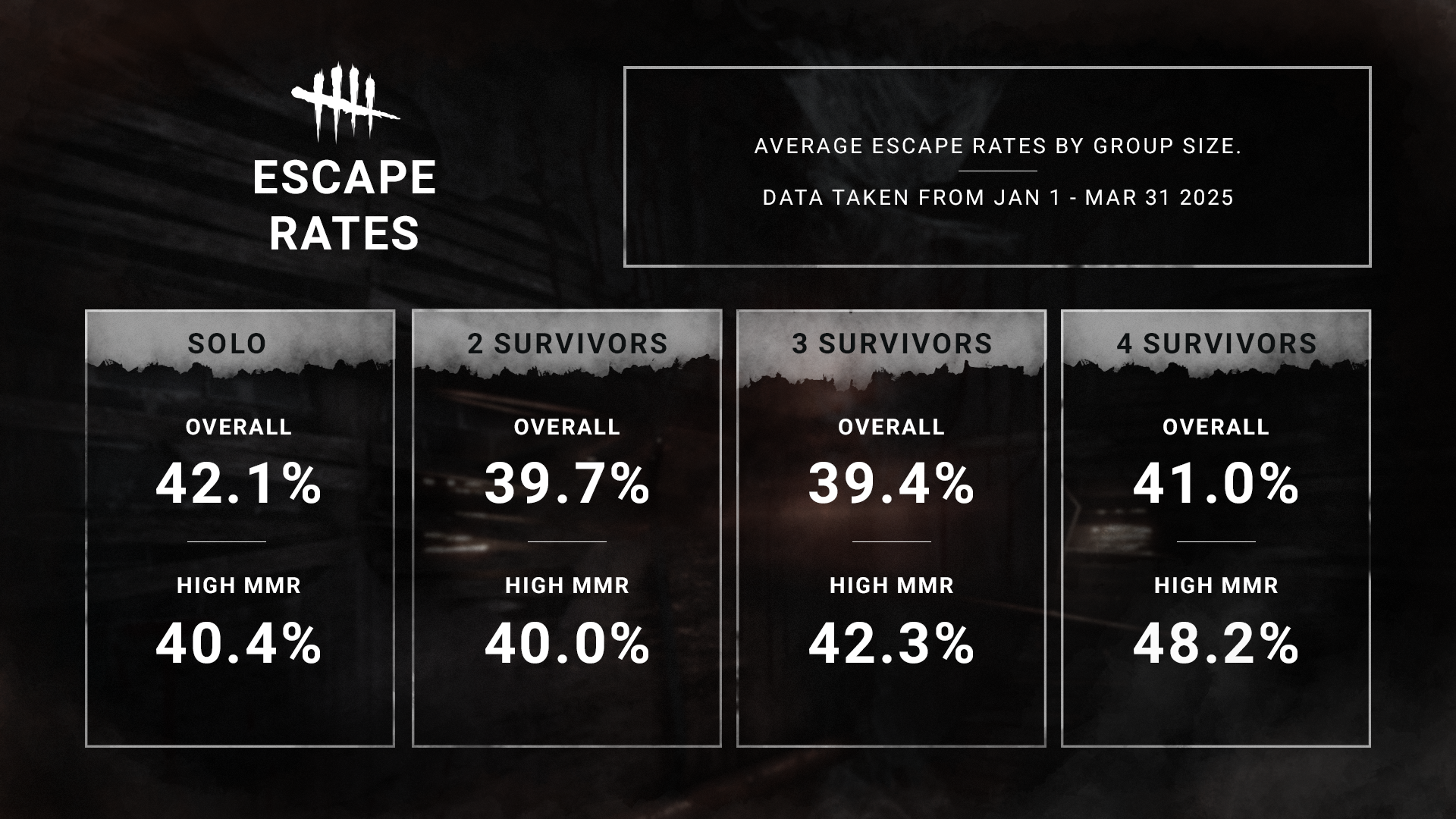
You are cherry picking one stat from this take and ignoring the overall statistic. Overall, SWF is balanced now.
Roughly 40-42% for the entire population, regardless of group size, and the largest escape rates being held by solo survivors.
Because you, and many others, see this chart and only focus on the number you want to see: that the smallest group of players (4 mans) in the highest skill tier of the game (top 5%) escape slightly more than the rest of the 99.5% of the population.
But that's all we're talking about here: maybe 0.5% of the population. Since 4 man SWF is about 10% of all players, and "high MMR" is already the top 5%, so 5% of 10% is 0.5%. probably not exact, but we're still taking about far less than even 5% of the total population here.
Which is really sad, that with maximum skill and extremely high level of coordination that players can still almost-but-not-quite achieve a fair game.
And we should never be balancing solely around the upper-most, top end of anything. Otherwise we need to discuss win streaks also. You don't balance for that, you balance for the overall population. And the data shows that they have done that now.
You are working backwards for this entire encyclopedia of text, starting with your decision that survivors should be nerfed, and you think gen speeds perks are the issue, and coming up with anything you can to try and rationalize that.
3 -
This might make sense if infinite gen time existed, but there are only 5 necessary gens on the map.
The number of gens being fixed doesn’t change the interaction, coordinated teams spend more total seconds repairing simultaneously, so percentage bonuses apply over more repair time before the fifth gen finishes, accelerating completion even with a fixed objective.
You complain about deja Vu specifically, which is a 6% increase. That saves 5.1 seconds off of a single gen if that gen is one of the 3 selected
andthat survivor completes the gen from 0 to 100%It doesn't save
moretime if that survivor is solo or in a group. It's saves 5.1 seconds max. Period.Im not complaining about Deja Vu specifically, the point is how percentage repair bonuses scale with coordinated uptime.
Yes, one survivor saves ~5 seconds alone, but when coordination increases simultaneous repair uptime across multiple survivors, that same percentage applies over more total repair time before the fifth gen finishes, which is where the scaling effect comes from.Gens are fixed times. The maximum bonus is already the worst case scenario here. There's no ‘extra gen time’ on this percentage.
Fixed gen time doesnt prevent scaling, it just caps the endpoint.
What changes is how much coordinated repair time occurs before that endpoint is reached. When coordination increases simultaneous uptime across multiple survivors, percentage bonuses are applied across more total repair seconds happening in parallel, which increases total objective progress gained before the match ends.What you're really wanting to complain about is survivors being efficient, which still isn't necessarily a group problem. Solo survivors can be efficient, and grouped/SWF survivors can be inefficient.
Efficiency isn’t the point, reliability and ceiling is. Coordination doesnt guarantee efficiency every match, but it raises the consistency and upper bound of sustained simultaneous repair uptime, which is exactly the variable percentage based repair bonuses scale from.
Your entire argument here is completely flawed because of this one fact
Its not flawed, that chart actually shows the exact effect being discussed.
Population averages are compressed by mixed skill levels and inconsistent coordination, while high MMR coordinated groups show a much larger separation, which is precisely where coordination scaling is expected to appear.Overall, SWF is balanced now.
Roughly 40-42% for the entire population, regardless of group size, and the largest escape rates being held by solo survivors.Population averages measure the average player, not coordination ceilings. The discussion has been about what happens when coordination is maximized, not what happens when players of mixed skill and mixed coordination are averaged together.
But that’s all we’re really talking about here: maybe 0.5% of the population.
Balance discussions often examine high mmr environments precisely because mechanics operate at full efficiency there. If a mechanic scales disproportionately with coordination, the effect will naturally appear strongest in that bracket. even if the overall population average remains close.
We should never be balancing solely around the upper-most, top end of anything.
No one said “solely.” The point is that understanding how mechanics scale at the coordination ceiling explains why the gap appears there, even when overall population averages stay similar.
You are working backwards for this entire encyclopedia of text, starting with your decision that survivors should be nerfed, and you think gen speeds perks are the issue, and coming up with anything you can to try and rationalize that
the argument didnt start with “survivors should be nerfed.”
It started with a mechanical observation- coordination increases sustained repair uptime, and percentage repair bonuses scale with that uptime, which explains why generator completion speeds separate most at the high coordination ceiling.Talking about how scaling works isn’t “deciding survivors need nerfs,” it’s describing why the performance gap appears under extreme coordination, whether any balance change follows from that or not. Iv given my opinion on a solution to close that gap. Not to nerf survivors as a whole.
-3 -
If you mention WoO as first perk I already doubt you understand the meaning of perks.
-2 -
It was present early, coordination increases repair uptime, and percentage repair bonuses scale with that uptime. Reexplaining the same point later doesnt mean it suddenly appeared there, it just means it was spelled out more clearly the second time.It was present early - where?
Coordination increases repair uptime - I'll get to this at the end
percentage repair bonuses scale with that uptime - as gets brought up throughout this post, why is that relevant compared to any other type of coordination?
it just means it was spelled out more clearly the second time - more like the 40th time, but at least we're getting to the point that the first posts at least weren't clear, which is progress.
The exampleswerethe reasoning. They showed coordination → more simultaneous repair uptime → more total repair time benefiting from percentage bonuses. Thats not confusing argument and conclusion, thats literally how arguments work.People are very aware that gen perks exist. That's not an example, that's a factual statement, much like someone just listing killers. The fact that something exists doesn't show a connection, an argument is you demonstrating that connection.
Nothing is being “pretended away.” Whats happening is that examples are being treated like they were the entire thesis, and then the clarification is being treated like a contradiction. That only works if you ignore what the examples were illustrating in the first place.What do your examples accomplish? How do they further your argument? Again, gen perks exist, that's not an example unless you can demonstrate that the perk has some broken effect for SWFs over soloq.
The math is actually very simple: percentage repair bonuses increase progress per second of repair time. If coordinated teams spend more total seconds repairing simultaneously, those bonuses apply for more seconds. More seconds × the same percentage bonus = more total progress. Not exactly advanced calculus.It's not advanced because you are overly simplifying a complex scenario into a base level equation.
And even if we take it just as this simple, you still need to determine how many seconds a coordinated SWF would achieve on gens over a similarly skilled soloq, then determine the value gained from gen perks. You get some incredibly small values without going for truly extreme scenarios - and then we're right back to trade offs.
Except the “final element” is a continuous objective that applies every second survivors are repairing. Earlier steps like heals or chase duration are conditional. Treating conditional boosts and continuous uptime scaling as identical is the part that doesnt make sense here.We're back to the idea that words are important. Conditional does not mean worse. It just means conditional. Continuous does not mean better, it just means continuous.
The reason you are saying it doesn't make sense is you are treating the perks as if they give you the same raw level of value (and thus frequency could be used to determine value). As has been repeated, that's not true and conditional perks tend to have massive values. Out of four matches, DS may only get value in one match, but that value might be an extra 15 to 45 seconds of chase time. Deja Vu might get value in all four matches, but it might might net ~5 seconds a match.
Both those perks would benefit from coordination. If anything, DS would benefit far more because all survivors would know it exists so they wouldn't have to waste time with body blocks allowing them to extract far more time from it.
By that note, if we're going to the extremes you seem to be, even gen perks are conditional. They are conditional depending on a survivor not being otherwise occupied (chased, downed, on hook) to be on gens.
Right, and the point being made isnt that gen perks are magically stronger in isolation, but that percentage based repair bonuses scale directly with sustained repair uptime. When coordination increases that uptime, the total value extracted from those bonuses increases too. Pretty straightforward interaction.Everything scales with coordination.
If survivors coordinate their heals better with healing perks, they get more value out of them. If they coordinate chases, they get more value. If they coordinate anti-tunnel, they get a lot more value.
See above that conditional does not mean worse. This continues with:
The comparison variable is total coordinated repair time. Apply a percentage bonus to a larger amount of repair time and you get proportionally more total progress. That’s the math being referenced, not a hidden spreadsheet somewhere.Percents aren't magic or unique to gens.
If coordination allows a survivor to get an extra 5 seconds on gens, and they have deja, that's 0.3 charges.
If coordination allows a survivor to use a We'll Make It one more time than they would have in soloq, that's 8 seconds per survivor, which is both a lot more in pure time and has the strategic value of getting healed quicker. You seem to be arguing that even if a gen perk gave a 1% bonus it would be broken for SWFs, when that should be, at least, obviously absurd.
That's why you need a math answer that looks at total value extracted and frequency of occurrence in comparison to an equally skilled soloq, because the simplicity of what you are laying out collapses really quickly when looking at actual game scenarios.
Communication and coordination reduce overlap, improve splitting, and minimize downtime between repairs, which keeps multiple survivors repairing simultaneously more consistently. That’s the mechanism, not some mysterious hidden tech, just coordinated efficiency being applied to a continuous objective.If that's all we're talking about, we're looking at really small levels of improvement compared to an equally skilled soloq. The benefits gained are going to be incredibly minor from gen perks over a soloq, especially when compared to what else SWFs could be using that soloq would struggle with.
5 -
It was present early- where?In the same place the mechanic has been the entire time, coordination increases simultaneous repair uptime, which means more total seconds where multiple survivors are repairing at once. Thats the variable percentage repair bonuses scale from.
percentage repair bonuses scale with that uptime- as gets brought up throughout this post, why is that relevant compared to any other type of coordination?Because generator repair is the match ending objective, and repair bonuses apply directly to the time spent performing that objective. Many other coordination benefits (heals, rescues, protections, etc.) are indirect, they may eventually translate into gen time, but repair bonuses convert coordinated repair uptime into objective progress immediately and continuously.
the first posts at least weren’t clear
Clarifying wording later doesn’t mean the mechanic suddenly appeared later, it just means the explanation became more explicit as the discussion kept circling around phrasing instead of the mechanic being discussed
People are very aware that gen perks exist. That's not an example, that's a factual statement, much like someone just listing killers. The fact that something exists doesn't show a connection, an argument is you demonstrating that connection.
Yup, and the connection has already been explained. The point isn’t just that perks exist, it’s that coordinated teams maintain higher simultaneous repair uptime, and percentage-based repair bonuses scale directly with that uptime. That’s the link being argued, coordination increases active repair time, and the bonuses gain more total value from it.
What do your examples accomplish? How do they further your argument? Again, gen perks exist, that's not an example unless you can demonstrate that the perk has some broken effect for SWFs over soloq.
They show that the perk doesn’t need to be broken.
When coordinated teams maintain higher simultaneous repair uptime, percentage based repair bonuses are active for more total seconds, which converts into more total objective progress from the same perk. Thats the connection the examples were pointing to.It's not advanced because you are overly simplifying a complex scenario into a base level equation.
And even if we take it just as this simple, you still need to determine how many seconds a coordinated SWF would achieve on gens over a similarly skilled soloq, then determine the value gained from gen perks. You get some incredibly small values without going for truly extreme scenarios - and then we're right back to trade offs.
Your calling it oversimplifying, but the relationship itself really is simple, percentage repair bonuses scale with total active repair time. The complex part is measuring how much coordinated teams increase that uptime, not wether the scaling exists.
And that’s the key point, even if the per perk gain looks small in isolation, uptime differences apply across multiple survivors simultaneously over the entire match, which is why the accumulated value shows up much more clearly at high coordination levels than in equally skilled solo play.
We're back to the idea that words are important. Conditional does not mean worse. It just means conditional. Continuous does not mean better, it just means continuous.
The reason you are saying it doesn't make sense is you are treating the perks as if they give you the same raw level of value (and thus frequency could be used to determine value). As has been repeated, that's not true and conditional perks tend to have massive values. Out of four matches, DS may only get value in one match, but that value might be an extra 15 to 45 seconds of chase time. Deja Vu might get value in all four matches, but it might might net ~5 seconds a match.
Both those perks would benefit from coordination. If anything, DS would benefit far more because all survivors would know it exists so they wouldn't have to waste time with body blocks allowing them to extract far more time from it.
By that note, if we're going to the extremes you seem to be, even gen perks are conditional. They are conditional depending on a survivor not being otherwise occupied (chased, downed, on hook) to be on gens.
The point isn’t that “continuous = better,” it’s that continuous effects scale directly with uptime, while conditional effects scale with event frequency, which is much less predictable.
A perk like DS can swing a single moment massively, but it doesn’t apply value every second of the match. Repair speed bonuses do, every additional second of coordinated repair time converts immediately into additional objective progress.
So yes, both are conditional in the broadest sense, but they scale very differently, one depends on specific events happening, the other depends on how efficiently survivors maintain repair uptime, thats is exactly what coordination increases.
Everything scales with coordination.
If survivors coordinate their heals better with healing perks, they get more value out of them. If they coordinate chases, they get more value. If they coordinate anti-tunnel, they get a lot more value.
Yup, everything improves with coordination, but not everything converts coordination into objective completion at the same rate.
Heals, anti-tunnel, or chase perks increase opportunity to do gens.

Repair-speed bonuses increase the rate of generator completion itself.
That difference is why repair speed scaling matters, when coordination increases sustained repair uptime across multiple survivors, percentage repair bonuses apply to every second of that increased uptime, turning coordination directly into faster objective progress rather than indirectly enabling it.
Percents aren't magic or unique to gens.
If coordination allows a survivor to get an extra 5 seconds on gens, and they have deja, that's 0.3 charges.
If coordination allows a survivor to use a We'll Make It one more time than they would have in soloq, that's 8 seconds
persurvivor, which is both a lot more in pure time and has the strategic value of getting healed quicker. You seem to be arguing that even if a gen perk gave a 1% bonus it would be broken for SWFs, when that should be, at least, obviously absurd.That's why you need a math answer that looks at total value extracted and frequency of occurrence in comparison to an equally skilled soloq, because the simplicity of what you are laying out collapses really quickly when looking at actual game scenarios.
Thats the whole point, the comparison variable is total coordinated repair time.
When a percentage bonus is applied across more total seconds of simultaneous repair, it naturally produces more total objective progress than when its applied across less repair uptime. There’s nothing “mystical” about that, it’s just how scaling works.
And to be clear, the argument was never that “any percentage bonus is automatically broken.”

The point is that percentage based repair bonuses scale directly with coordinated uptime, which means coordinated swfs extract more total value from the same multipliers than equally skilled solo teams.

That scaling effect, not the existence of the bonuses themselves.If that's all we're talking about, we're looking at really small levels of improvement compared to an equally skilled soloq. The benefits gained are going to be incredibly minor from gen perks over a soloq, especially when compared to what else SWFs could be using that soloq would struggle with.
Small per second gains don’t remain small when four survivors apply them across an entire match. Coordinated uptime turns the same percentage bonuses into more total objective progress. Also gen multipliers aren't just limited to perks.
Post edited by top500spiderman on-1 -
In the same place the mechanic has been the entire time, coordination increases simultaneous repair uptime, which means more total seconds where multiple survivors are repairing at once.Where?
We've gone from pretending away to pretending in. Which takes us to:
the first posts at least weren’t clearClarifying wording later doesn’t mean the mechanic suddenly appeared later, it just means the explanation became more explicit as the discussion kept circling around phrasing instead of the mechanic being discussedHere's my full quote - "more like the 40th time, but at least we're getting to the point that the first posts at least weren't clear, which is progress."
All you're changing in your response is clear to explicit - clear was more accurate.
Yup, and the connection has already been explained. The point isn’t just that perks exist, it’s that coordinated teams maintain higher simultaneous repair uptime, and percentage-based repair bonuses scale directly with that uptime. That’s the link being argued, coordination increases active repair time, and the bonuses gain more total value from it.Yup, and the connection has already been explained. - No, the connection has been repeated, but never defended or explained in terms of responses.
If I said Doctor was an S Tier killers exist and my evidence amounted to
-S Tier killers exist
-Doctor can blast multiple survivors off of gens, and gens are the ultimate objective
-Therefore Doctor is S Tier
If I just kept repeating that second line and not dealing with the actual numbers and counter scenarios everyone else proposes, that's not an explanation, its repetition without answers.
Your calling it oversimplifying, but the relationship itself really is simple, percentage repair bonuses scale with total active repair time. The complex part is measuring how much coordinated teams increase that uptime, not wether the scaling exists.This scaling exists for all coordination. There is nothing unique about gen perks/items.
The complex part is very important (and why oversimplification is dangerous) because its needed to back up your argument that its the gen perks/items which are causing the difference. Without the complex part you are just saying that the more efficient the survivors are, the more value they get - that's just a true statement regardless of builds or SWF/soloq.
The point isn’t that “continuous = better,” it’s that continuous effects scale directly with uptime, while conditional effects scale with event frequency, which is much less predictable.Much less predictable - So what?
Again - a major effect that occurs every four games might be much more worthwhile than a minor effect that occurs every game.
We're back to words matter - predictable does not equal better.
You keep using words like predictable or continuous in place of showing that this is actually better.
A perk like DS can swing a single moment massively, but it doesn’t apply value every second of the match. Repair speed bonuses do, every additional second of coordinated repair time converts immediately into additional objective progress.So yes, both are conditional in the broadest sense, but they scale very differently, one depends on specific events happening, the other depends on how efficiently survivors maintain repair uptime, thats is exactly what coordination increases.One scales frequently at a small value, one scales infrequently at a massive value.
Without specific numbers either one of those could be preferable.
That scenario exists for both soloq and SWF, that part isn't unique. Coordination can increase the value, but that remains true for both.
Yup, everything improves with coordination, but not everything converts coordination into objective completion at the same rate.This is like frequency. The rate doesn't matter without factoring in the overall value achieved.
Heals, anti-tunnel, or chase perks increase opportunity to do gens.
Repair-speed bonuses increase the rate of generator completion itself.That difference is why repair speed scaling matters, when coordination increases sustained repair uptime across multiple survivors, percentage repair bonuses apply to every second of that increased uptime, turning coordination directly into faster objective progress rather than indirectly enabling it.Option A - gives survivors more time on gens
Option B - survivors get more out of their time on gens
Without looking at the numbers of the value actually derived, neither of those is better or worse. Both scenarios increase the value that is drawn out of gens. There's still nothing unique about gen perks and still a lot of reasons they have less of an impact for SWFs.
Thats the whole point, the comparison variable is total coordinated repair time.When a percentage bonus is applied across more total seconds of simultaneous repair, it naturally produces more total objective progress than when its applied across less repair uptime. There’s nothing “mystical” about that, it’s just how scaling works.And to be clear, the argument was never that “any percentage bonus is automatically broken.”
The point is that percentage based repair bonuses scale directly with coordinated uptime, which means coordinated swfs extract more total value from the same multipliers than equally skilled solo teams.
That scaling effect, not the existence of the bonuses themselves.That's how scaling works - That's how scaling works for everything. At the extreme, upper end SWFs will be a little more efficient. You try to argue that the gen perks are better from this efficiency because they are more frequent (continuous, rate, etc.), but as pointed out above it's not how frequently something occurs which is relevant, but what's the actual value derived and then (for this discussion) compared to what an equally skilled soloq would get.
Small per second gains don’t remain small when four survivors apply them across an entire match. Coordinated uptime turns the same percentage bonuses into more total objective progress. Also gen multipliers aren't just limited to perks.Not really. Again, a high skilled soloq will be slightly less efficient than a coordinated SWF, but we're looking at small differences for gen perks (but large differences for some other perks).
As for things that aren't perks - this is even a smaller difference. If a survivor brings a toolbox and built to last, again the SWF will help, but if a highly skilled survivor is using a gen rush build, they're going to gen rush.
To summarize all this
Frequent, continuous, rate, etc. aren't inherently better. To determine what's better the total derived value needs to be looked at.
The more efficient survivors are, the better. At the extreme upper end, coordinated SWFs will be more efficient than the equivalent soloq, but that efficiency is shown in all elements of the game.
For comparisons of what you propose, you need some standard for how much you think coordinated SWFs are gaining over an equally skilled soloq. That could then be compared to other possible builds. I think gen perks/items provide one of the smallest levels of benefit on the SWF to soloq comparison.
All of that then has to be discussed in how trials actually occur, which brings up issues like trade offs, differing killers, etc.
4 -
Where?
All my early post were about Gen potential in swfs and still are.
Here's my full quote - "more like the 40th time, but at least we're getting to the point that the first posts at least weren't clear, which is progress."
All you're changing in your response is clear to explicit - clear was more accurate.
…? lol
Yup, and the connection has already been explained.- No, the connection has been repeated, but never defended or explained in terms of responses.If I said Doctor was an S Tier killers exist and my evidence amounted to
-S Tier killers exist
-Doctor can blast multiple survivors off of gens, and gens are the ultimate objective
-Therefore Doctor is S Tier
If I just kept repeating that second line and not dealing with the actual numbers and counter scenarios everyone else proposes, that's not an explanation, its repetition without answers.
You’re calling it “repetition” because you keep asking for an explanation that’s already been spelled out, then pretending it wasn’t.
The mechanism isn’t complicated: coordination increases total simultaneous repair uptime, and percentage repair bonuses scale directly with how many total seconds survivors are repairing. More coordinated repair time = more value extracted from the same multiplier.
That’s not “Doctor is S-tier because gens exist.”
It’s basic scaling logic. If you keep hearing the same explanation, it’s not because it hasn’t been given — it’s because you keep arguing around it instead of engaging with it.This scaling exists for all coordination. There is nothing unique about gen perks/items.
The complex part is very important (and why oversimplification is dangerous) because its needed to back up your argument that its the gen perks/items which are causing the difference. Without the complex part you are just saying that the more efficient the survivors are, the more value they get - that's just a true statement regardless of builds or SWF/soloq.
Yes, scaling exists for all coordination, that’s obvious. The point isn’t that gen perks are the only thing that scale, it’s that generator progress is the win condition, and percentage repair bonuses apply directly to that objective every second survivors are repairing.
Other coordinated advantages (heals, anti-tunnel, chase perks, etc.) are indirect, they eventually translate into gen time if things go well. Repair bonuses skip that extra step and convert uptime straight into objective progress. That’s the distinction.
And I’m not claiming “perks alone cause the entire difference.” The point is that coordination increases repair uptime, and repair-speed multipliers amplify the value extracted from that increased uptime, meaning the same coordinated time produces more objective completion than it otherwise would.
So yes, the “complex part” is measuring how large that effect is, but acknowledging that the interaction exists and directly compounds coordinated uptime isn’t oversimplification, it’s just describing the mechanic accurately.
Much less predictable- So what?Again - a major effect that occurs every four games might be much more worthwhile than a minor effect that occurs every game.
We're back to words matter - predictable does not equal better.
You keep using words like predictable or continuous in place of showing that this is actually better.
“Predictable” wasn’t being used to mean “automatically better,” it was used to explain how the value scales.
Conditional perks can have big moments, but their value depends on specific events, nobody argued otherwise. The difference is that continuous effects apply every second survivors are performing the objective, so any coordination advantage that increases total repair uptime is converted into objective progress immediately and repeatedly, rather than depending on specific events happening first.
So the point isn’t “predictable = better.”
The point is that continuous effects scale directly with uptime, while conditional effects scale with event frequency, which means coordination affects their value extraction in very different ways.One scales frequently at a small value, one scales infrequently at a massive value.
Without specific numbers either one of those could be preferable.
That scenario exists for both soloq and SWF, that part isn't unique. Coordination can increase the value, but that remains true for both.
without numbers, either can be preferable per activation. Thats not the disagreement.
The difference is repair speed bonuses scale with total coordinated repair uptime across the entire match, while large conditional effects scale only with how often their trigger conditions occur. Coordination increases the value of both, but it raises repair uptime far more consistently than it raises rare trigger events, which is why percentage repair bonuses extract more cumulative value from coordination over time.
So the claim isn’t that conditional perks can’t be strong, it’s that continuous objective-speed effects compound coordination more reliably, which is why their impact becomes more noticeable in highly coordinated teams even when the same perks exist in solo play.
This is like frequency. The rate doesn't matter without factoring in the overall value achieved.
Rate matters because rate determines how much value accumulates over the match.

A large but rare effect can be strong per activation, but continuous objective speed effects convert every extra second of coordinated uptime into progress, so their total impact can be larger even if each individual gain is smaller.Option A - gives survivors more time on gens
Option B - survivors get more out of their time on gens
Without looking at the numbers of the value actually derived, neither of those is better or worse. Both scenarios increase the value that is drawn out of gens. There's still nothing unique about gen perks and still a lot of reasons they have less of an impact for SWFs.
They both increase gen value, the distinction is how the value scales with coordination.
“More time on gens” depends on events happening (injuries, chases, rescues), so the amount of extra time varies match to match.

“More value per second on gens” applies every second survivors are repairing, so when coordination increases sustained simultaneous repair uptime, that bonus compounds continuously across the team.
So the claim isn’t that gen perks are magically unique, it’s that objective speed multipliers scale more consistently with coordinated uptime, which is why their cumulative impact becomes more noticeable in highly coordinated groups.
- That's how scaling works for everything. At the extreme, upper end SWFs will be a little more efficient. You try to argue that the gen perks are better from this efficiency because they are more frequent (continuous, rate, etc.), but as pointed out above it's not how frequently something occurs which is relevant, but what's the actual value derived and then (for this discussion) compared to what an equally skilled soloq would get.
scaling exists for everythingt he distinction is where the scaling applies.
Many coordinated benefits only create the opportunity to gain gen time and depend on events occurring. Repair speed multipliers apply directly to the objective every second survivors are repairing, so when coordinated teams maintain higher simultaneous repair uptime, the same efficiency difference is converted into more total objective progress, not just more opportunities.
the point isnt that frequency alone decides value, it’s that objective-speed multipliers convert coordination into match progress more directly, which is why their cumulative impact becomes more visible when comparing equally skilled coordinated teams to solo play.
Not really. Again, a high skilled soloq will be slightly less efficient than a coordinated SWF, but we're looking at small differences for gen perks (but large differences for some other perks).
As for things that aren't perks - this is even a smaller difference. If a survivor brings a toolbox and built to last, again the SWF will help, but if a highly skilled survivor is using a gen rush build, they're going to gen rush.
To summarize all this
Frequent, continuous, rate, etc. aren't inherently better. To determine what's better the total derived value needs to be looked at.
The more efficient survivors are, the better. At the extreme upper end, coordinated SWFs will be more efficient than the equivalent soloq, but that efficiency is shown in all elements of the game.
For comparisons of what you propose, you need some standard for how much you think coordinated SWFs are gaining over an equally skilled soloq. That could then be compared to other possible builds. I think gen perks/items provide one of the smallest levels of benefit on the SWF to soloq comparison.
All of that then has to be discussed in how trials actually occur, which brings up issues like trade offs, differing killers, etc.
yea, efficiency improves everything that’s not the revelation you think it is. The point isn’t that gen perks are the only thing affected by coordination, it’s that they’re the one category that converts that efficiency directly into win condition progress every single second.
Heals, saves, information, anti-tunnel, all of those eventually translate into gen time if things go well. Repair-speed multipliers don’t need a “maybe later” step, they’re already sitting on the objective bar, turning every extra second of coordinated uptime into progress immediately.
So when you say “we’re looking at small differences,” you’re treating those seconds like they happen once. They don’t. They happen simultaneously across multiple survivors for the entire match, which is exactly why the cumulative effect shows up at the coordination ceiling.
Nobody is arguing that coordination doesn’t help everything. That’s obvious. The point, the one you keep circling around is that objective speed multipliers are the place where that efficiency compounds continuously, not occasionally. Calling that “one of the smallest benefits” without accounting for how many total seconds those bonuses are active is just hand waving the scaling away instead of actually addressing it.
-2 -
Let me highlight a line that I think encapsulate the issues:
“Predictable” wasn’t being used to mean “automatically better,” it was used to explain how the value scales.Then why did you say predictable instead of actually demonstrating the numbers?
You say continuous - I point out it doesn't mean better, just continuous, you say you weren't arguing that, then you go right back to it.
You say predictable - I point out it doesn't mean better, just predictable, you say you weren't arguing that and go right back to it.
As we'll see in your post, you really struggle to explain how these are better without just using these words as if they mean better (I'm going to hit this point a lot here)
The mechanism isn’t complicated: coordination increases total simultaneous repair uptime, and percentage repair bonuses scale directly with how many total seconds survivors are repairing. More coordinated repair time = more value extracted from the same multiplier.The counter is also incredibly simple.
There's nothing about this that is unique to gen perks. You will say you agree with that, but you never address how the gen perks are actually superior without falling back to the continuous argument.
It’s basic scaling logic. If you keep hearing the same explanation, it’s not because it hasn’t been given — it’s because you keep arguing around it instead of engaging with it.Or potentially its because you keep refusing to engage with the counter arguments and keep repeating a mechanic.
To look at scaling you need multiple elements - such as how much and what are the other possibilities?
Yes, scaling exists for all coordination, that’s obvious. The point isn’t that gen perks are theonlything that scale, it’s that generator progress is the win condition, and percentage repair bonuses apply directly to that objective every second survivors are repairing.It being the win condition is completely irrelevant. All the gen speed in the world won't matter if survivors are constantly being downed/eliminated (for multiple possible reasons that perks could help with)
This is like arguing in American football teams should always throw the ball because you gain more yards that way or in basketball always go for threes because that's more points - that's silly, its a simple explanation, but just because something is simple doesn't mean its right especially when you have lots of mechanics involved.
Other coordinated advantages (heals, anti-tunnel, chase perks, etc.) are indirect, theyeventuallytranslate into gen time if things go well. Repair bonuses skip that extra step and convert uptime straight into objective progress. That’s the distinction.We're right back to direct does not equal better.
Extra steps does not equal worse.
If an indirect action yields a greater return than a direct action, then its better. The relevance is the outcome - continuous, predictable, direct, etc are neither inherently better or worse.
And I’m not claiming “perks alone cause the entire difference.” The point is that coordination increases repair uptime, and repair-speed multipliers amplify the value extracted from that increased uptime, meaning the same coordinated time produces more objective completion than it otherwise would.So yes, the “complex part” is measuring how large that effect is, but acknowledging that the interaction exists and directly compounds coordinated uptime isn’t oversimplification, it’s just describing the mechanic accurately.Except you're distinguishing a mechanic that isn't separate.
The more time a survivor spends on gens, the more use they'll get out of gen perks.
The more times they heal, the more value they'll get out of heal perks.
The more they are in chase, the more value they'll get out of chase perks.
SWFs can hypothetically maximize the efficiency of all of these better than a soloq could via coordination. When you say describing a mechanic accurately again you're saying a part no one disagrees with, more time using perk = more value, you might as well keep repeating there's 4 survivors to 1 killer.
Conditional perks can have big moments, but their value depends on specific events, nobody argued otherwise. The difference is that continuous effects apply every second survivors are performing the objective, so any coordination advantage that increases total repair uptime is converted into objective progress immediately and repeatedly, rather than depending on specific events happening first.You say nobody argued otherwise, then go right into that argument.
Immediately, repeatedly, continuous, do not equal better.
You're saying you do not say these words mean better, but than immediately use them again as the justification for the argument.
That's the repetition I mentioned.
So the point isn’t “predictable = better.”The point is that continuous effects scale directly with uptime, while conditional effects scale with event frequency, which means coordination affects their value extraction in very different ways.Very different ways - no one disagrees with that. It's a core concept of DbD's perk design which I've mentioned, situational perks with really strong effects, or easy to access perks with minor effects. That's not a SWF vs soloq issue. Now if you start talking about some of the situational perks, you can see a lot of much strong SWF possibilities over soloq.
without numbers, eithercanbe preferable per activation. Thats not the disagreement.Either can be preferable? Okay, great, we're at the point that we actually have to compare perks. Let's see where we go from here.
The difference is repair speed bonuses scale with total coordinated repair uptime across the entire match, while large conditional effects scale only with how often their trigger conditions occur. Coordination increases the value of both, but it raises repair uptime far more consistently than it raises rare trigger events, which is why percentage repair bonuses extract more cumulative value from coordination over time.So the claim isn’t that conditional perks can’t be strong, it’s that continuous objective-speed effects compound coordination more reliably, which is why their impact becomes more noticeable in highly coordinated teams even when the same perks exist in solo play.And instead of doing that we're right back to
Consistently does not equal better
Continuous does not equal better
Direct does not equal better
Cumulative value from coordination over time does actually mean better, but you actually have to show the cumulative value, not just rely on all the other words.
Additionally, you'd need to show SWFs getting more value out of something like Deja Vu over many matches compared to something like DS in comparison to what an equally skilled soloq could manage with those perks to actually demonstrate your point.
This is like frequency. The rate doesn't matter without factoring in the overall value achieved.Rate matters because rate determines how much value accumulates over the match.
A large but rare effect can be strong per activation, but continuous objective speed effects convert every extra second of coordinated uptime into progress, so their total impact can be larger even if each individual gain is smaller.Let's look at my quote - rate doesn't matter without factoring in the overall value achieved.
That should answer everything you type here. Rate, direct, continuous, predictable, etc. don't matter - what matters is the end result.
On the last thing you type there - "total impact can be larger even if each individual gain is smaller."
Sure, no one disagrees with that in concept.
Demonstrating it with the perks/items that exist in game, in comparison to soloq, in comparison to what else SWFs could run is the issue.
They both increase gen value, the distinction is how the value scales with coordination.“More time on gens” depends on events happening (injuries, chases, rescues), so the amount of extra time varies match to match.
“More value per second on gens” applies every second survivors are repairing, so when coordination increases sustained simultaneous repair uptime, that bonus compounds continuously across the team.So the claim isn’t that gen perks are magically unique, it’s that objective speed multipliers scale more consistently with coordinated uptime, which is why their cumulative impact becomes more noticeable in highly coordinated groups.Varies does not equal worse.
Consistently does not equal better.
If through coordination, a SWF gets an extra ~5 seconds out of their gen perks than they would have compared to soloq every trial, and if coordination nets them an extra 50 seconds out of using DS once every five trial compared to soloq, well on raw numbers DS wins (then we get into strategic applications of these issues which adds another layer to the discussion - because the mechanics in DbD for what is better/worse aren't actually simple)
scaling exists for everythingt he distinction is where the scaling applies.Many coordinated benefits onlycreate the opportunityto gain gen time and depend on events occurring. Repair speed multipliers apply directly to the objective every second survivors are repairing, so when coordinated teams maintain higher simultaneous repair uptime, the same efficiency difference is converted into more total objective progress, not just more opportunities.the point isnt that frequency alone decides value, it’s that objective-speed multipliers convert coordination into match progress more directly,So I'd just be repeating myself here as this is the same things. Directly does not equal better.
If you have a preference for predictable values whose value are more consistent, that's great. No one says you can't. But that doesn't make it objectively better.
which is why their cumulative impact becomes more visible when comparing equally skilled coordinated teams to solo plaSo this is difficult to prove/disprove because who is soloq and who is SWF is never known unless you are in the SWF or its streamers.
I've been in soloq games where the killer accused us of gen rush despite being soloq. One or two good chases, a team of decent survivors, the gens are going to fly. I've watched SWFs become incredibly inefficient when the things don't go their way.
But if this was the absolute best strategy, we're right back to why aren't more SWFs running it, especially in things like no limit comp matches. Or we can look to Japan were the survivors have higher escape rates and are considered far more efficent, yet they have the self heal meta were sometimes all the survivors are burning multiple perk slots on healing builds.
At some point there should be something demonstrating this mechanic especially given the self evident nature you seem to think it has.
yea, efficiency improves everything that’s not the revelation you think it is. The point isn’t that gen perks are theonlything affected by coordination, it’s that they’re the one category that converts that efficiency directly into win condition progress every single second.The revelation should be 'that doesn't matter'.
You're right back to arguing that continuous equals better. Without getting into numbers on overall value achieved, the distinction is irrelevant.
Heals, saves, information, anti-tunnel, all of thoseeventuallytranslate into gen time if things go well. Repair-speed multipliers don’t need a “maybe later” step, they’re already sitting on the objective bar, turning every extra second of coordinated uptime into progress immediately.We're back to trade-offs.
The problem with the 'maybe later' scenario is what do the survivors do if that situation arises and they aren't prepared for it? This is back to the idea as well that with how you define things, gen perks are also conditional. If a survivor needs anti-tunnel, and doesn't have anti-tunnel, that maybe later becomes extremely important.
And many of these things, such as heals, unhooks, chases, happen in the vast majority of DbD matches.
So when you say “we’re looking at small differences,” you’re treating those seconds like they happen once. They don’t. They happen simultaneously across multiple survivors for the entire match, which is exactly why the cumulative effect shows up at the coordination ceiling.Literally doesn't reflect anything I've typed. You even quoted me above connected rate to overall impact.
Rate x value x frequency = overall value compared to the same scenario for soloq.
Nobody is arguing that coordination doesn’t help everything. That’s obvious. The point, the one you keep circling around is that objective speed multipliers are the place where that efficiency compounds continuously, not occasionally. Calling that “one of the smallest benefits” without accounting for how many total seconds those bonuses are active is just hand waving the scaling away instead of actually addressing it.Continuously does not equal better.
Again, if the argument is not you are saying these things are better, you need to stop relying them as a substitute for better.
Presuming small benefits over multiple seconds outweigh less frequent large benefits is pretending in an argument instead of making it.
Again, I've laid out multiple examples (as have others) of what SWFs might actually achieve with these perks. You have not. How many extras seconds of repair time do think a coordinated SWF is gaining on average over an equally skilled soloq? If you actually have a starting point on numbers and how many perks you thinks a SWF should be/are dedicating as gen perks, that actually gives you points for comparison. If you actually look at real number possibilities, you have to imagine some truly extreme scenarios to make these gen perks/items seem to have anything more than a minor impact in comparison to soloq.
5 -
I disagree with your fundamental point that "gen rush" is too strong or whatever, but unironically i think this is a really cool concept to play with. Reduce the number of pallets available at the start to something like 6-8 depending on the map (focusing on putting them in the more balanced tiles), but also put an additional 10-12 "pallet build spots" that require some number of seconds to build (maybe 5 for balanced ones, 8 for safer pallets or something). in addition get rid of crap filler pallet.
IMO it probably wouldn't work as written here, but it'd be really cool to do a PTB with something like that just to get a fresh perspective on balancing
-2 -
Let me highlight a line that I think encapsulate the issues:
“Predictable” wasn’t being used to mean “automatically better,” it was used to explain how the value scales.Then why did you say predictable instead of actually demonstrating the numbers?
You say continuous - I point out it doesn't mean better, just continuous, you say you weren't arguing that, then you go right back to it.
You say predictable - I point out it doesn't mean better, just predictable, you say you weren't arguing that and go right back to it.
As we'll see in your post, you really struggle to explain how these are better without just using these words as if they mean better (I'm going to hit this point a lot here)
You keep treating this like the claim is “continuous = better,” when the actual point is about what coordination scales.
Coordination increases sustained repair uptime, and percentage repair bonuses convert that uptime directly into objective progress. That’s a mechanical relationship, not a vocabulary argument.
“Numbers matter” determines how big the effect is, not whether the scaling exists.
The counter is also incredibly simple.
There's nothing about this that is unique to gen perks. You will say you agree with that, but you never address how the gen perks are actually superior without falling back to the continuous argument.
Your saying it’s not unique because “everything scales with coordination,” but that ignores what it scales into.
Repair-speed bonuses scale directly into objective completion. Most other perks scale into opportunity.
That difference is the entire point, and dismissing it as “continuous argument again” doesn’t refute it.
Or potentially its because you keep refusing to engage with the counter arguments and keep repeating a mechanic.
To look at scaling you need multiple elements - such as how much and what are the other possibilities?
Your framing this as if repeating the mechanic means it’s unproven. It just means your counter hasn’t broken it.
And “we need numbers” isn’t a rebuttal, it’s just saying you don’t like the implication of the scaling relationship.
The mechanism is simple:
More coordinated repair time → more seconds benefiting from percentage bonuses → more total objective progress.If that relationship is wrong, show where it breaks. Otherwise we’re just circling.
It being the win condition is completely irrelevant. All the gen speed in the world won't matter if survivors are constantly being downed/eliminated (for multiple possible reasons that perks could help with)
This is like arguing in American football teams should always throw the ball because you gain more yards that way or in basketball always go for threes because that's more points - that's silly, its a simple explanation, but just because something is simple doesn't mean its right especially when you have lots of mechanics involved.
Calling the win condition “irrelevant” in a discussion about scaling objective completion is wild.
And sports analogies don’t replace math.
The claim isn’t “simple = correct.”
It’s that the scaling relationship is structurally straightforward, whether you like the implication or not.We're right back to direct does not equal better.
Correct. Direct does not automatically equal better.
But direct does mean the effect applies to the win condition immediately and continuously.
That matters when we’re discussing scaling under coordination.
You’re acting like “not inherently better” means “irrelevant.” It doesn’t.
Extra steps does not equal worse.
Also correct.
But extra steps introduce additional failure points and variability.
Heals, anti-tunnel, and chase perks depend on:
- Killer behavior
- Hook states
- Map position
- Timing windows
Repair speed bonuses depend on:
- Survivors being on gens
One is event-gated. The other is uptime-gated.
Those are not structurally identical.
If an indirect action yields a greater return than a direct action, then its better.
Sure, if it yields a greater return.
But that’s a numerical question, not a structural one.
The structural point is this:
- Conditional perks spike in isolated moments.
- Percentage repair bonuses apply to every second of coordinated uptime.
In coordinated high-MMR environments where uptime is already maximized, continuous scaling becomes more reliable and compounding.
That doesn’t mean “always better.”
It means “more sensitive to uptime increases.”The relevance is the outcome - continuous, predictable, direct, etc are neither inherently better or worse.
Right, but you keep pretending the argument is about adjectives.
It’s not.
It’s about how value accumulates over time under coordination.
If coordination increases total simultaneous repair uptime across four survivors, percentage bonuses extract more total value from that uptime.
That’s not wordplay.
That’s how scaling works.If you want to argue the magnitude is small, argue magnitude.
But pretending the scaling relationship itself doesn’t matter because “direct isn’t automatically better” just sidesteps the actual point.
Except you're distinguishing a mechanic that isn't separate.
The more time a survivor spends on gens, the more use they'll get out of gen perks.
The more times they heal, the more value they'll get out of heal perks.
The more they are in chase, the more value they'll get out of chase perks.
SWFs can hypothetically maximize the efficiency of all of these better than a soloq could via coordination. When you say describing a mechanic accurately again you're saying a part no one disagrees with, more time using perk = more value, you might as well keep repeating there's 4 survivors to 1 killer.
You’re repeating “everything scales with use” like that ends the discussion.
Yes, more time doing X = more value from X. No one disputes that.
The distinction is what that value converts into.
- Heal perks convert into survivability.
- Chase perks convert into time.
- Anti-tunnel converts into safety.
- Repair bonuses convert directly into generator completion — the win condition.
That’s the difference.
Saying “the more time on gens, the more value you get” isn’t refuting the argument — it’s restating it.
The point isn’t that gen perks are the only things that scale.
It’s that when coordination increases sustained simultaneous repair uptime across multiple survivors, percentage repair bonuses apply to every second of that uptime and convert it straight into objective progress.Other perks can create time.
Repair bonuses turn time into progress at a higher rate.That’s not “4 survivors vs 1 killer.”
That’s explaining why certain scaling interacts more directly with the win condition.If you want to argue that indirect scaling produces more total objective progress in high MMR SWFs than uptime-based repair scaling does, then show that.
But just saying “everything scales” doesn’t actually engage with the distinction being made.
You say nobody argued otherwise, then go right into that argument.
Immediately, repeatedly, continuous, do not equal better.
You're saying you do not say these words mean better, but than immediately use them again as the justification for the argument.
That's the repetition I mentioned.
You’re still acting like I’m arguing “continuous = automatically better.”
I’m not.
I’m saying continuous repair bonuses scale directly with sustained uptime, and sustained uptime is exactly what coordination increases.
That’s not a word game, that’s a mechanical relationship.
“Immediately” and “repeatedly” aren’t being used as value judgments. They describe how the effect applies:
- Conditional perks require a trigger.
- Repair bonuses apply every second survivors are repairing.
Whether that produces more total objective progress depends on how much uptime coordination creates, which is the actual debate.
You keep reframing it as if I’m saying “continuous therefore superior,” when the claim is:
Coordination increases sustained repair uptime →
Repair multipliers apply to every second of that uptime →
More total objective progress is extracted from the same multiplier.If you think that interaction doesn’t meaningfully contribute to the high MMR gap, argue that.
But reducing it to “you said continuous again” isn’t engaging with the scaling argument, it’s sidestepping
Very different ways - no one disagrees with that. It's a core concept of DbD's perk design which I've mentioned, situational perks with really strong effects, or easy to access perks with minor effects. That's not a SWF vs soloq issue. Now if you start talking about some of the situational perks, you can see a lot of much strong SWF possibilities over soloq.
You’re reframing this as “situational vs minor effects,” when that’s not the distinction being made.
The distinction is how value scales.
Continuous repair bonuses scale with uptime.
Uptime is exactly what coordination increases.That means coordinated teams extract more total value from the same percentage bonus than equally skilled solo teams.
That’s not about “minor vs major.” It’s about scaling mechanics.
And when you say “that’s a core design philosophy issue,” you’re actually conceding the structure of the argument — you’re just moving it to a broader category.
Also, pointing out that situational perks can be strong in SWF doesn’t counter this. Yes, coordination amplifies those too. The difference is:
- Event perks scale with event frequency.
- Repair bonuses scale with total active repair time.
- Generator completion is the win condition.
So if coordination primarily increases sustained repair uptime, then the perks that scale with uptime naturally convert coordination into objective progress more consistently.
That’s the argument. Not “predictable = better.” Not “minor > major.”
Scaling interaction.And instead of doing that we're right back to
Consistently does not equal better
Continuous does not equal better
Direct does not equal better
Cumulative value from coordination over time does actually mean better, but you actually have to show the cumulative value, not just rely on all the other words.
Additionally, you'd need to show SWFs getting more value out of something like Deja Vu over many matches compared to something like DS in comparison to what an equally skilled soloq could manage with those perks to actually demonstrate your point.
You keep saying “show cumulative value.
That’s exactly what sustained uptime is.
If coordination increases total simultaneous repair time across four survivors, then percentage bonuses applied to that time naturally generate more total progress.
Event perks scale with moments.
Repair bonuses scale with uptime.Coordination increases uptime more consistently than it increases rare trigger events. .
Let's look at my quote - rate doesn't matter without factoring in the overall value achieved.
That should answer everything you type here. Rate, direct, continuous, predictable, etc. don't matter - what matters is the end result.
On the last thing you type there - "total impact can be larger even if each individual gain is smaller."
Sure, no one disagrees with that
in concept.Demonstrating it with the perks/items that exist in game, in comparison to soloq, in comparison to what else SWFs could run is the issue.
Rate is part of total value.
Total value = value per second × total seconds applied.
You can’t say “rate doesn’t matter” while asking about overall impact — rate directly determines accumulation over time.Small per-second gains across four coordinated survivors for an entire match can absolutely outscale large but rare effects. That’s just how scaling works.
If you want to argue the magnitude is small, argue it.
But dismissing rate entirely while asking for total value doesn’t make sense.
Varies does not equal worse.
Consistently does not equal better.
If through coordination, a SWF gets an extra ~5 seconds out of their gen perks than they would have compared to soloq every trial, and if coordination nets them an extra 50 seconds out of using DS once every five trial compared to soloq, well on raw numbers DS wins (then we get into strategic applications of these issues which adds another layer to the discussion - because the mechanics in DbD for what is better/worse aren't actually simple)
You’re still comparing isolated perk value instead of team-wide uptime scaling.
Gen multipliers apply to every second of coordinated repair across multiple survivors. That compounds all match long.
DS giving +50 seconds once every five games isn’t the same type of scaling as four survivors converting coordinated uptime into objective progress every second they’re repairing.
This isn’t “consistent = better.”
It’s that sustained uptime × percentage scaling accumulates continuously, not situationally.If you think the cumulative gain is small, quantify it.
But treating single-event spikes and continuous team-wide scaling as equivalent math isn’t accurate.
So I'd just be repeating myself here as this is the same things. Directly does not equal better.
If you have a preference for predictable values whose value are more consistent, that's great. No one says you can't. But that doesn't make it objectively better.
You keep reducing it to “direct ≠ better” like that’s the whole argument.
The distinction isn’t preference — it’s accumulation.
Opportunity-based perks require events.
Repair multipliers convert every second of coordinated uptime into objective progress.That’s not about liking “predictable value.”
It’s about sustained team-wide scaling versus conditional spikes.If you think the cumulative impact is negligible, show that.
But pretending both scale the same way just sidesteps the mechanism.So this is difficult to prove/disprove because who is soloq and who is SWF is never known unless you are in the SWF or its streamers.
I've been in soloq games where the killer accused us of gen rush despite being soloq. One or two good chases, a team of decent survivors, the gens are going to fly. I've watched SWFs become incredibly inefficient when the things don't go their way.
But if this was the absolute best strategy, we're right back to why aren't more SWFs running it, especially in things like no limit comp matches. Or we can look to Japan were the survivors have higher escape rates and are considered far more efficent, yet they have the self heal meta were sometimes all the survivors are burning multiple perk slots on healing builds.
At some point there should be something demonstrating this mechanic especially given the self evident nature you seem to think it has.
Anecdotes don’t disprove scaling.
“Yes, I’ve seen solo gens fly” just shows efficiency exists — not that coordination + uptime scaling doesn’t amplify multipliers.
“Why aren’t more SWFs running it?” isn’t a rebuttal either. Meta choice depends on trade-offs, killer pool, map, comp rules, etc. Something not being universally spammed doesn’t mean the scaling interaction doesn’t exist.
And saying “we can’t always tell who’s SWF” doesn’t negate the mechanism, it just limits perfect observation. The math of uptime × percentage bonus doesn’t stop working because group labels aren’t visible.
Your reframing this as “continuous = better,” when that’s not the claim.
The claim is about compounding. Repair-speed multipliers apply to the win condition every second survivors are repairing. Coordination increases how many total seconds that happens simultaneously across the team. That’s where the cumulative difference comes from.
Yes, everything scales with coordination. The distinction is that some effects scale through event frequency (chases, unhooks, anti-tunnel), while repair multipliers scale through sustained uptime on the objective itself. One is conditional on specific triggers. The other compounds every second the team maintains pressure.
Saying “show the numbers” is fair — but dismissing the scaling logic entirely because we haven’t attached a spreadsheet yet doesn’t make the mechanism disappear.
If your position is that the total compounded gain from coordinated uptime + multipliers is negligible compared to other perks, then that’s the comparison to argue.
But reducing it to “small frequent vs big rare” misses the structural difference: one compounds directly into objective completion every second, the other doesn’t.
-3 -
There's a character count limit, never hit that before, this will be two posts.
We're going backwards, you keep trying to build an argument, I knock down what you bring up, and you fall back to base level mechanics as if that's the argument.
Your big issue in this post is scaling. You've fallen back to that arguing like I somehow think it doesn't exist, despite using quotes from me that actually talk about the scaling effects.
But just for frame of reference I said earlier -
Everything scales with coordination.And then you agreed! You said -
Yup, everything improves with coordination, but not everything converts coordination into objective completion at the same rate.I then went on to talk about objective completion rate relevance, which you barely touch in this post. Instead, you try to act like a mechanic is under argument that is not. We're not going in circles, you keep falling backwards out of anything that is a meaningful argument.
Anyway onto the post.
You keep treating this like the claim is “continuous = better,” when the actual point is aboutwhat coordination scales.Coordination increases sustained repair uptime, and percentage repair bonuses convert that uptime directly into objective progress. That’s a mechanical relationship, not a vocabulary argument.“Numbers matter” determineshow bigthe effect is, notwhether the scaling exists.I keep treating the argument that continuous = better because that keeps being your argument.
Scaling isn't magical. It's math.
Your saying it’s not unique because “everything scales with coordination,” but that ignores what it scalesinto.Repair-speed bonuses scale directly into objective completion. Most other perks scale into opportunity.That difference is the entire point, and dismissing it as “continuous argument again” doesn’t refute it.What refutes it, which I've said, is that its irrelevant on its own. As I'll repeat myself throughout the post, rate is only one component of overall value.
Anyway, you quote me saying 'everything scales with coordination', this is the top of your post, that's going to answer a lot of your question.
Your framing this as if repeating the mechanic means it’s unproven. It just means your counter hasn’t broken it.No, its been pretty thoroughly destroyed, you just keep coming back to it and I keep trying.
And “we need numbers” isn’t a rebuttal, it’s just saying you don’t like the implication of the scaling relationship.Continuing to say 'scaling relationship' without addressing the numbers means you don't actually have a response to show how this is actually advantageous. You're falling back to mechanics as if that's somehow the disagreement.
The mechanism is simple:More coordinated repair time → more seconds benefiting from percentage bonuses → more total objective progress.If that relationship is wrong, show where it breaks. Otherwise we’re just circling.Because you're stating a fact, not making an argument. Like I said, you might as well keep repeating 4 survivors, 1 killer as if that's an argument without discussing the entire game.
Using a perk more gets more value out of it. Everyone knows that. That's not related to SWF or soloq at all and is true for multiple perks in the game.
Calling the win condition “irrelevant” in a discussion about scaling objective completion is wild.And sports analogies don’t replace math.The claim isn’t “simple = correct.”It’s that the scaling relationship is structurally straightforward, whether you like the implication or not..Saying something is wild isn't proof, it's not even an argument. Survivors have to do multiple things in a match, you basically agree to them later in your post when talking about high MMR tradeoffs.
As for the analogy, if you don't have a response I've gotten used to it. I've tried math, I've tried scenarios, I thought I'd give analogies a try. Hopefully at some point you engage with something.
Correct. Direct does not automatically equal better.But directdoesmean the effect applies to the win condition immediately and continuously.That matters when we’re discussing scaling under coordination.You’re acting like “not inherently better” means “irrelevant.” It doesn’t.So you say correct, then automatically try to argue the opposite.
As for "acting like" - this is why I like to quote you, in full. You say I argue adjectives, but that's because I want to give the person an actual chance to defend what they said (what they are 'acting like'). Despite your use of quote around 'irrelevant', every time I've used it I've attached it to other numbers or overall value. Having a single number in a math equation, especially one that is multiplication, is irrelevant without the other factors.
Also correct.But extra steps introduce additional failure points and variability.Heals, anti-tunnel, and chase perks depend on:Killer behaviorHook statesMap positionTiming windows
Repair speed bonuses depend on:Survivors being on gens
One is event-gated. The other is uptime-gated.Again, you say correct, then try to argue the opposite.
Simple does not equal better.
Those are not structurally identical.Not only have I never said they are structurally identical, I literally went into major vs minor benefits that you've referenced in this post. The relevant factors is the overall value and strategic implications that can be gained from perks/items in multiple matches.
Sure, if it yields a greater return.But that’s a numerical question, not a structural one.The structural point is this:Conditional perks spike in isolated moments.Percentage repair bonuses apply toevery second of coordinated uptime.
In coordinated high-MMR environments where uptime is already maximized, continuous scaling becomes more reliable and compounding.That doesn’t mean “always better.”It means “more sensitive to uptime increases.”Is saying sure, then arguing against what you said the theme of this post?
My quote was - If an indirect action yields a greater return than a direct action, then its better.
"More sensitive to uptime increases" does not make it worse. All that means is that it doesn't happen as frequently. As I've said, at some point you need to provide some numbers.
Right, but you keep pretending the argument is about adjectives.It’s not.It’s abouthow value accumulates over time under coordination.If coordination increases total simultaneous repair uptime across four survivors, percentage bonuses extract more total value from that uptime.That’s not wordplay.That’s how scaling works.If you want to actually argue math, give some numbers on what you think the difference is. I've brought that up on a few occassions.
If you want to argue the magnitude is small, argue magnitude.But pretending the scaling relationship itself doesn’t matter because “direct isn’t automatically better” just sidesteps the actual point.No one has ever argued scaling doesn't matter. You literally quote me in this post talking about the differences of minor vs major events. You proceed to do that right now:
You’re reframing this as “situational vs minor effects,” when that’s not the distinction being made.The distinction ishow value scales.Continuous repair bonuses scale with uptime.Uptime is exactly what coordination increases.That means coordinated teams extract more total value from the same percentage bonus than equally skilled solo teams.That’s not about “minor vs major.” It’s about scaling mechanics.That's still scaling mechanics, just minor vs major. In one case the team is increasing how frequently they gain a minor benefit, in the other case they are increasing how frequently they get a major benefit. You need all the numbers to discuss it.
Post edited by crogers271 on0 -
Part 2 because of character limits
And when you say “that’s a core design philosophy issue,” you’re actually conceding the structure of the argument — you’re just moving it to a broader category.Have been since we've been on this topic. Literally repeated this argument in multiple posts when I've compared how the same scaling happens with other types of perks.
Also, pointing out that situational perks can be strong in SWF doesn’t counter this. Yes, coordination amplifies those too. The difference is:Event perks scale with event frequency.Repair bonuses scale with total active repair time.Generator completion is the win condition.
So if coordination primarily increases sustained repair uptime, then the perks that scale with uptime naturally convert coordination into objective progress more consistently.Consistently does not equal better.
The differences you cite aren't actually math that back up your argument, they're presumptions which have no relevance without numbers.
The thing you are leaving out of your scenarios is value. Just because an event is frequent doesn't make it better if the value it actually gives is still much less than an infrequent event with a large value.
That’s the argument. Not “predictable = better.” Not “minor > major.”Scaling interaction.You say that, but you literally just made that argument again. See consistently above. You keep having to add these words that you say don't mean better, but without them your argument falls apart.
You keep saying “show cumulative value.That’s exactly what sustained uptimeis.Let's look at my actual quote - Rate x value x frequency = overall value compared to the same scenario for soloq.
You need a comparison for this to have relevance. If used more = better is not something anyone has ever argued against.
If coordination increases total simultaneous repair time across four survivors, then percentage bonuses applied to that time naturally generate more total progress.Event perks scale with moments.Repair bonuses scale with uptime.Coordination increases uptime more consistently than it increases rare trigger events. .Consistently does not equal better. Overall value is what mattters.
Rateis part oftotal value.Total value = value per second × total seconds applied.You can’t say “rate doesn’t matter” while asking about overall impact — rate directly determines accumulation over time.Lol, this is the second time you've misquoted this same thing
Let's look at my full quote - rate doesn't matter without factoring in the overall value achieved.
Rate is ONE OF the factors that determines overall value achieved. That word "without" is incredibly important. I literally gave you an equation that I've quoted again in this response.
Just because something has a high rate has no relevance without the other factors.
Small per-second gains across four coordinated survivors for an entire match can absolutely outscale large but rare effects. That’s just how scaling works.Just going to quote myself again to show how I've already said that:
"On the last thing you type there - "total impact can be larger even if each individual gain is smaller."
Sure, no one disagrees with that in concept.
Demonstrating it with the perks/items that exist in game, in comparison to soloq, in comparison to what else SWFs could run is the issue."
If you want to argue the magnitude is small, argue it.I have, multiple times. You literally quote me doing one of those arguments right after this, and you haven't made a response to my requests for how much value you actually think survivors are getting out of their gen perks in a soloq in comparison to a SWF.
But dismissing rate entirely while asking for total value doesn’t make sense.Good thing I didn't dismiss rate entirely.
You’re still comparingisolated perk valueinstead ofteam-wide uptime scaling.Gen multipliers apply toevery secondof coordinated repair across multiple survivors. That compounds all match long.DS giving +50 seconds once every five games isn’t the same type of scaling as four survivors converting coordinated uptime into objective progress every second they’re repairing.This isn’t “consistent = better.”It’s that sustained uptime × percentage scaling accumulates continuously, not situationally.Sustained does not equal better. That's just you putting in a new word for consistent.
More survivors doesn't equal better, it just enhances the trade off discussion. If one survivors gets an extra five seconds over equivalent soloq on a gen with Deja Vu, that's 0.3 charges. If all four survivors do this, that's 1.2 charges, but that's a trade off of all four survivors trading off for an additional perk.
If you think the cumulative gain is small, quantify it.What do you think I've been doing every time I've laid out these scenarios? Why do you think I ask you for what you think the numbers are?
But treating single-event spikes and continuous team-wide scaling as equivalent math isn’t accurate.Presuming just because they are a team that they don't face the same risks on trade off value of perks isn't accurate. Do they have an advantage on it do to preplanning? Sure, but that's not unique to gen perks/items.
You keep reducing it to “direct ≠ better” like that’s the whole argument.The distinction isn’t preference — it’s accumulation.You literally say I keep talking about cumulative value earlier and now you are agreeing its what matters. Not sure what the point of everything else you said was if you're just going to agree with me, but, great, end result.
Opportunity-based perks require events.Repair multipliers convertevery second of coordinated uptimeinto objective progress.Events happen.
That’s not about liking “predictable value.”It’s about sustained team-wide scaling versus conditional spikes.Sustained does not equal better. There's a killer, he's going to do things, having counters to what he does is very important.
If you think the cumulative impact is negligible, show that.So I love the continued demands I show something, which I've actually dived into multiple times, despite you not showing it, despite it being your argument. If you want to go back to arguing something like Full Circuit sure, but when I or @FerrousFacade tried to focus on those arguments you said that wasn't the point of the discussion
Anecdotes don’t disprove scaling.“Yes, I’ve seen solo gens fly” just shows efficiency exists — not that coordination + uptime scaling doesn’t amplify multipliers.“Why aren’t more SWFs running it?” isn’t a rebuttal either. Meta choice depends on trade-offs, killer pool, map, comp rules, etc. Something not being universally spammed doesn’t mean the scaling interaction doesn’t exist.And saying “we can’t always tell who’s SWF” doesn’t negate the mechanism, it just limits perfect observation. The math of uptime × percentage bonus doesn’t stop working because group labels aren’t visible.So this whole part here sounds great, until you actually look at what part of your post I'm replying to - "which is why their cumulative impact becomes more visible when comparing equally skilled coordinated teams to solo play"
You're making an anecdotal argument, I'm responding in kind, though I'm backing it up with both personal experience and high MMR examples.
The claim is aboutcompounding. Repair-speed multipliers apply to the win condition every second survivors are repairing. Coordination increases how many total seconds that happens simultaneously across the team. That’s where the cumulative difference comes from.Yes, everything scales with coordination.Glad you're back to agreeing with me that everything scales with coordination, not sure why you spend so long posting about the scaling mechanic for something you are going to agree with.
The distinction is that some effects scale throughevent frequency(chases, unhooks, anti-tunnel), while repair multipliers scale throughsustained uptime on the objective itself. One is conditional on specific triggers. The other compounds every second the team maintains pressure.So I was about to say compounds does not equal better, which is true, but even better, that's not what compounds means.
Gen perks add a straight linear line of benefit. Each additional second on a gen equal the amount of extra charges from the gen perks/items being used. Compounding would be something like Deja Vu growing in value with each use.
Saying “show the numbers” is fair — but dismissing the scaling logic entirely because we haven’t attached a spreadsheet yet doesn’t make the mechanism disappear.No one is dismissing the scaling logic that you are now falling back to. It's uniqueness to the perks/items you have chosen in addition to its relevance to the difference between SWF/soloq at the upper end is the issue.
And we don't need a spreadsheet. Roughly how much value do you think a coordinated SWF would extract from these gen perks in comparison to an equally skilled soloq? As I've said, if you start laying out actual figures, you need to lay out some truly absurd scenarios to make these perks seem significant.
If your position is that the total compounded gain from coordinated uptime + multipliers is negligible compared to other perks, then that’s the comparison to argue.That argument has been made multiple times. It's actually more detailed than that, because your argument is specifically about SWF vs soloq.
I've posted multiple times about how the difference between gen perks on soloq and SWFs would be relatively minor, especially compared to other game perks that SWFs can far more easily extract more coordinated value from.
But reducing it to “small frequent vs big rare” misses the structural difference: one compounds directly into objective completion every second, the other doesn’t.Consistent does not equal better. Direct does not equal better. You keep saying that's not your argument, but you keep making it.
0 -
At this point it just feels like you’re debating a ghost version of the argument instead of what’s actually being said.
You keep cycling through the same three lines:
- “Everything scales.”
- “Continuous doesn’t equal better.”
- “Show numbers.”
And every time the scaling interaction gets explained, you flatten it into a vocabulary debate like that somehow resets the board.
Let’s be clear.
You’ve already agreed that:
- Coordination increases sustained simultaneous repair uptime.
- Percentage repair bonuses apply per second of repair time.
- Total value accumulates over time.
That’s the mechanism.
So when you reply with “continuous ≠ better,” you’re not refuting anything, you’re arguing against a claim no one made.
It’s like you’re trying to win by semantic exhaustion.
“Yes, everything scales with coordination.”
Congratulations. That was never the disagreement.
The disagreement is about what it scales into.
Healing scales into survivability.
Chase perks scale into time.
Repair multipliers scale directly into objective completion.Flattening that into “all scaling is the same” doesn’t make it true. It just makes the discussion pointless.
And the “show numbers” move would land a lot harder if you were willing to estimate the only variable that matters — how much additional sustained simultaneous repair uptime coordinated SWFs maintain over equally skilled solo teams.
But instead of engaging there, you keep looping back to “continuous doesn’t equal better” like it’s a magic spell.
repeatedly reframing the argument into something easier to swat down just makes the conversation circular.
At some point it stops looking like a counter and starts looking like deliberate deflection. But that seems to be your go to when you cant win a argument.
-2 -
Man, logging on to see the votes was a mistake...
0