Stop using kill rates as evidence of anything...
Comments
-
Ok it's very clear not only can you not read, but you also love to twist words around so you can make your argument make sense (it still doesn't). I'm done with you. You're so hopped up on this idea of me being a tunneler and me comparing multihooking to tunneling that you've completely and constantly ignored my point that has nothing to do with tunneling. Like genuinely, you are
weird.Simple question for you, since you are refusing to engage with this point:
What does 'general' look like?
Because you used that word to dodge away from thinking about why you used the term 'harder'. And the term 'harder' is, literally, COMPARATIVE.
So what is it that you are comparing it to?
I've said countless times, multihooking as an individual playstyle is bad because you are actively delaying yourself from reaching the killer objective, of kills. You can say you aren't, but you
factuallyare.Explain how hooking survivors keeps you from killing them! Explain how hooking survivors slows you down when it comes to getting kills.
Because you CAN'T explain that without pointing at tunnelling and saying that that gets the job done -faster-. Which, once again, means you're judging multihooking off of tunnelling.
The fact that I can give you a literal quote of the person saying "yes, it depends on the matchmaker giving you bad players" and you somehow manage to twist it into a sentence never uttered is genuinely remarkable.
Give me the literal quote then. NOT your paraphrasing, but the literal quote. Show me where Hens says that you have to be significantly better than your opponents to be able to win by multihooking.
8 -
Explain how hooking survivors keeps you from killing them! Explain how hooking survivors slows you down when it comes to getting kills.
If you are multihooking, that means your goal is to spread out hooks and to get more hooks! That means you aren't killing things! Because instead of going for a kill! You're going for hooks!
😮
You're actively making kills the secondary objective, and hooks the primary objective!!! Do you get it now? Was that put simple enough for you?
Give me the literal quote then. NOT your paraphrasing, but the literal quote.
???
I literally did. It was in the reply that you replied to. It was right there IN quotation marks. That was directly from his pinned comment.
His own comment section was literally calling him out about it and saying what I'm saying lmfao.
-7 -
In other words, a 50% win rate for a killer would be balanced, a 50% win rate for each member of the team with multiple opponents would effectively crush the single player.
Tripping over the starting line here. How are you going to call it balanced when one side has a 50% winrate, and the other one is lower than that?
Wouldn't it be balanced if both sides had the exact same winrate?
9 -
Is it objectively bad, or is it objectively WORSE than other options?
I think that's what everyone is hung up on. Multi-hooking is viable for pretty much everyone, but it is certainly more difficult and riskier than tunneling someone out early. It's actually straight-up better for you as a player, because tunneling will let you slack in other areas as a Killer and never really develop certain skills.
Tunneling is easier and definitely stronger than multi-hooking. It has a considerable amount less risk and a exponentially bigger payoff.
So, if you were to say that multi-hooking is objectively WORSE than tunneling someone out, I think a lot of people would agree, but to claim it isn't a viable strategy is false.
10 -
If you are multihooking, that means your goal is to spread out hooks and to get more hooks! That means you aren't killing things!
You aren't killing things?
So if you spread hooks, then suddenly, survivors… DON'T die on the third hook?
Or do they still die… Just not as quickly as they do with tunnelling?
You're actively making kills the secondary objective, and hooks the primary objective!!!
That's also not true at all, either. Multi-hooking doesn't mean getting 8 hooks evenly spread across everyone.
???
I literally did. It was in the reply that you replied to. It was right there IN quotation marks. That was directly from his pinned comment.
Except nowhere in the quote does he state that you have to be significantly better than your opponent to win via multihooking, he just said that he was for this particular experiment.
Here, let me quote you the salient bits:
(…) The entire point of this is that if you are good enough you can win almost any game because you outskill your opponents.
(…)
BUT in the majority of games that you play you can win if you are just good enough at playing Killer.
These are his remarks on the viability of multihooking. No, he doesn't say, anywhere, that you need to be way better than your opponents to win via multihooking. He says that a sufficiently competent killer player can win with high consistency with multihooking.
That's not multihooking being 'bad'. It's not even multihooking being 'decent'. That's multihooking being strong.
Because that's where competent killer players are at. That's where BHVR put them. They are really, really strong.
7 -
Tournaments are irrelevant, my dear friend.
They are external, filled with rules that most DBD trials do not have, and experienced only by a very small minority. It is a show for entertainment and amusement, not something that matters when it comes to balancing the game.
Well, you said, and I quote:
I can comfortably say that if a survivor team loses to multihooking they are bad, because I have yet to be proven otherwise.
But, as we've established, that just isn't the case. There are nine years of proof.
That said, here is where we get to consistency. Now here I'll have to make a disclaimer because if we're thinking of recent times, then yes, it is possible for it not to be consistent, but not because it isn't viable, but because of how easier it is to tunnel someone out. It is no secret that survivors lost many of the resources they had at their disposal, and without them tunneling gets way easier to do.
Which is a massive problem. Like I said earlier, tunneling wasn't a massive issue in the Old DBD because survivors had more lines of defenses against it. A killer who wanted to tunnel would have to go through many resources that survivors currently no longer have. Multihooking never stopped being viable, the alternative just got increasingly less punishing. Until now, as we thankfully seem to be moving on to a mitigation or removal of tunneling from DBD.
You denying that does not change that, that is the fact and that is what every top killer has said since the dawn of time.
Your sentence here doesn't make it a fact, either.
Just because good survivors have lost to multihooking before in a 9 year span, does not mean that it's good and viable.
And just because good survivors have won against multihooking before in a 9 year span, does not mean that it's bad and not viable.
13 -
It's all anecdotal so realistically it means nothing. I'm sharing the amount of opportunity killers have over survivors in the same situation.
4 -
At the same time every survivor in DBD is apparently bad at the game but killers need to use the tunneling at 5 gens comp strat to win. Uh huh
10 -
And just because good survivors have won against multihooking before in a 9 year span, does not mean that it's bad and not viable.
Okay if you wanna act like the amount of good survivor teams beating multihooking isn't vastly far and away higher compared to good survivor teams that have lost to multihooking, then sure man. We can be delusional and live in this fantasyland for your sake.
-11 -
There are so many problems with this post.
MMR is a joke. You keep bringing up MMR as some Holy Grail. In reality, matchmaking in this game is so loose that MMR might as well not even exist. In back to back matches, I'll play against SEAL Team SWF with 5k+ hours apiece, then against a bunch of baby survivors that don't combine for 500 hours. I went up against my first comp team my very first week of playing the game. I was backfilled into their lobby and got my butt handed to me. What, had I already "boosted" my way into Top MMR in my first ten hours of playing?
I could probably get 4e'd a thousand times in a row, and I'd still be going against the exact same survivors I am now. The idea that I've "boosted" my way into an inappropriate MMR is absurd, because after a minute or two of queueing up, the system just grabs a random killer or survivor to slot into an empty slot to get a match going.If you want to make MMR actually mean something, then I'm all for that. If losing my butt off for a couple of months meant I'd never have to play against these SWF squads ever again, I'd do it in a heartbeat. Let these hardcore squads sit in a lobby for half an hour while they wait for Lilith Omen or Hens to become available. But that's not how it's going to work. I'm still going to go up against these same teams, I'm just going to do so with fewer tools at my disposal to even further guarantee that I'm getting my teeth kicked in.
-8 -
Double Post
-1 -
If killers had started throwing games to deflate the stats, absolutely not. Killrates have never been a good indication of balance. Nurse proves that.
-8 -
Replying to your reply to me. It's a fair point. I was just pointing out that even the most experienced players have it in their playbook to tunnel, but yes, as you said, tournaments to have special rules mostly having survivors playing with one hand tied behind their back.
-2 -
I don't know where people come up with the idea that only survivors are nerfed in comp games. It depends on the tournament, but nurse is almost always banned, sometimes blight, slugging is usually banned until end game, so are some killer perks, and I'm sure other things I'm not even thinking of. Survivors typically can't duplicate perks, no duplicate items (unless found in match), and certain perks may be banned as well. Sounds like both sides have equal nerfs in place.
3 -
While browsing the forum, I found it particularly interesting that, although both sides—killers and survivors—may have their complaints, the direction of those complaints is fundamentally different.
Killers tend to express frustration with structural issues such as matchmaking or game balance. They rarely demand that survivors play a certain way or criticize their tactics wholesale.
Survivor mains, on the other hand, often direct their anger toward killers’ in-game behavior—strategic choices or playstyles that are entirely within the rules and meant to win the game.
This reveals something quite telling: that some survivors seem more focused on limiting killers’ options in the name of morality than on improving their own skill. In other words, they’re not asking for fairness—they’re asking for handicaps and babysitting.
They’re essentially saying:
“I don’t want to try harder, so I’d like you to go easier on me,”
wrapped in the convenient packaging of “fair play.”Camping, tunneling, slugging, and hook control are all legitimate tactics based on judgment and risk management. There is nothing shameful about them.
Those who insist otherwise—calling them “toxic,” “dishonorable,” or “cheap”—have likely abandoned not just competitive killer play, but also any serious effort as survivors themselves.
To all killer players out there:
Don’t be brainwashed by survivor hypocrisy disguised as morality.
Trust your tactical decisions, and play with confidence.And to all who claim you can get a 4K by playing “MORALLY” as killer —
Then by all means, play that way yourself.
But don’t tell other killer players how they should play.-6 -
I want to see this game increase the kill rates to 70ish percent just to see the metal gymnastics the killer players will use to still convince themselves that the game is “massively survivor sided”
4 -
You can't just ignore math and game balance.
I'm not. You are, by making base assumptions that your "model" isn't capturing. That's what I've been trying to explain.
Clear and coherent evidence, and "Nooo, ignore the evidence!" just isn't going to cut it.
Your method here is anything except coherent. So I'll just outline why it's incorrect.
There's a reason BHVR shoots for a 60% kill rate, and…now I hope you're sitting down for this, it's because of math. :O
I hope you're sitting down for this, the 60% kill rate is not because "it's balanced", it's because they "wanted the killer to feel more powerful to capture a horror feeling" and specifically not because 60% is "balanced" gameplay. They've intentionally, deliberately, and knowingly skewed the game balance in the killer's favor. And not because of balance, literally because they felt like it.
Anyway, here is the statistics of balance.
This is an awful lot of numbers that have literally nothing to do with Dead by Daylight in any way.
So, since I expect you to learn nothing and keep repeating this drivel, as a Math teacher, I'll go through why this is completely, objectively useless information when discussing the game so that the rest of the class can maybe understand why I'm pushing back on this.
At minimum, there are a lot more variables to consider, and even then I wouldn't look at it as a "probability" of escaping. These percentages are supposed to be descriptive of actual data, not predictive of how a random match with human players will actually play out.
Asymmetric PvP isn't Probablility
Let's look at your assumptions: Survivors all have a 50% chance to escape, each.
So, at minimum, we're ignoring every factor that would impact this. Not every survivor on the team is going to be of the same skill level, and I highly suspect that the matchmaker deliberately puts a "weak link" and a "slightly stronger link" on the team to bias the match toward more kills. Even if the matchmaker isn't going that far, it's a pretty huge stretch to think that there is never a weak link on the team. It's a pvp game, and the bare minimum here would be a skill comparison, even in a naively bare bones statistical analysis.
This also doesn't bring any of the actual PvP, or human elements, or even RNG into consideration. The biggest one being how do these players play? Because, and I already brought this up, let's take the example that the killer is playing to hard tunnel the first person out of the game. (You know, how people are arguing on these forums, and in this very thread that every match must be played, every time, period).
So if the killer just hard camps and tunnels the first player they see, what is the chance that player is going to die? Honestly, there's still too many factors to really give an accurate number, but given that it's simply a race to get 3 hooks vs finishing 5 gens, and this is the meta, it's a lot more than 50% of the time.
In fact, if we use the limited data from Nightlight, and acknowledge that this is somewhat curated data from community-provided sources, and is nowhere near enough of a sample size to make a definitive statement about the entire DbD population, we get this (as of today):
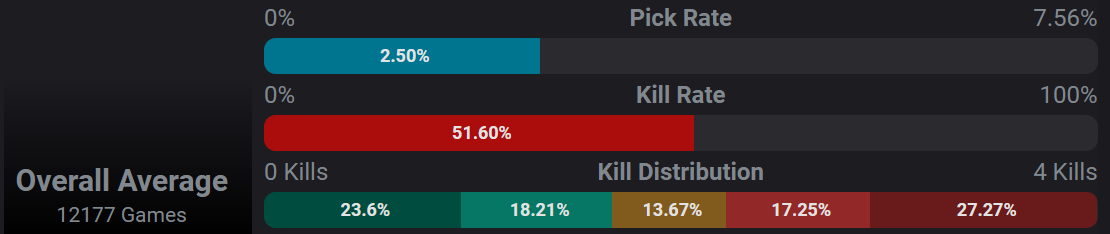
So, if anything, the "chance" of the first survivor dying isn't "50%", it's not even close. There's about a 23.6% chance of them escaping, and the rest of the time they die (76.4%). That's about as far from a "coin flip" as you can get.
Where are the Gens (Other variables)?
I'm really curious where you think that match time, or even simply "gens" factors into this. Especially since the biggest complaint is that "killers don't have enough time" (Gens go too fast).
Since that's missing from your analysis completely… The most common interpretation, given how the game works, would either be:
- Each of these assumes 5 gens.
- Each of these assumes n+1 gens (one more gen than the number of survivors).
Both of these interpretations fall apart when you look at the chart. You can't honestly tell me that in a 1v1 scenario that the survivor is finishing either 2 or 5 gens 50% of the time. That doesn't hold up to any scrutiny whatsoever. In fact, the 1v1 survivor doesn't have anywhere close to a 50% chance here, it's not a matter of if they die, but when. (More on the 1v1 scenario later)
And if you fix the number of gens to 5, then somehow you're saying the killer is still going to win a 1v10 more than half the time. That doesn't seem right either, even at a passing glance.
This method isn't even passing the "sniff" test at this point.
In fact, this graph can be expanded as far as you like, and will never have the killer winning less than half the time. So apparently, you've also "proven" that a 1v20 game is "balanced". Think about that one for a minute, and you might start to understand why I take issue with this "analysis".
(As I said before, this is because you're working backwards from the assumption "it's balanced" and trying to make the data fit that… so at every level of this your data is showing that it's physically impossible for the killer to win less than half the time, which is certainly a choice. This is even displayed in one of your graphs…).
Snowballing and Independence
So the biggest flaw in your method here is the prevalence of snowballing. Tunneling is the biggest factor, and the reason that I say that these are not "independent" variables. Because once you get one survivor out, if there is enough time in the match (i.e. gens remaining) you basically automatically can win the remaining 1v3. That's the gamble that people take all the time with tunneling.
And that isn't captured in your data whatsoever. You are blindly assuming that every survivor has the same chance to escape, and that doesn't match with anything in the game, or any of the data we have available.
Because the killer isn't simply killing one survivor, then has an even chance to kill the next one. Snowballing is a core part of DbD emergent gameplay for the killer.
Here's a visual representation of how wrong your analysis is. When you make incorrect assumptions, like assuming every survivor has the same chance of survival (regardless of any other factors), you get the blue line in this graph. When you look at the only data we have available to us (the Nightlight overall data above) you get the red line.
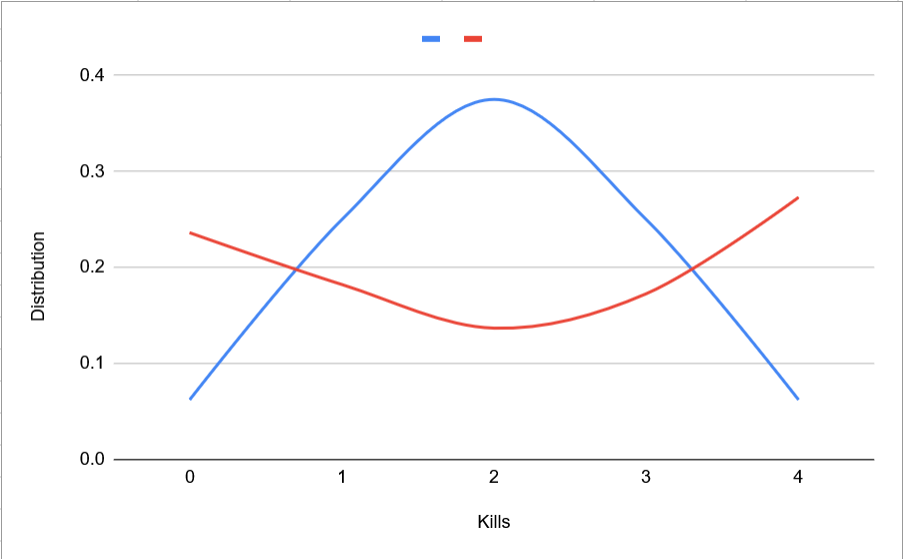
No one. Ever. Should look at this and say that your approximation here is accurately representing even the limited data we do have. These are not the same model, and whatever you are actually modeling in blue here does not in any way describe or model what happens in game.
Mismatching Kill Rate and "Win" Rate
Look at your own data. The very first point is wrong. You readily admit and know that BHVR aims for a 60% kill rate. So why would this not appear in your chart. In fact, you brag about the fact that your chart "shows" a 61.5% win rate for the killer… but that is not the kill rate.
At every level of your analysis this fails to capture anything that we already have available to us as actual game data. One big example would be, if we know the kill rate is 60%, so why would you think that a 1v1 situation has a 50% chance ever? Even if we go with the incorrect analysis, we should be capturing that a 1v1 is a 60% kill rate. And a second of consideration, as I mentioned earlier, would show that a 1v1 has basically a 100% kill rate, since the survivor will eventually lose and cannot do gens.
But let's look at your 1v4 "data": a 61.56% win rate for killer. so 61.56% of the time the game is either a 3k or 4k, which is literally the information you present here.
So, on the extreme end, if every single "winning game" is exactly a 3k and every "non-winning" game is a 0k (the worst case scenario for the killer that matches your data), then you get a 46.17% kill rate. On the other extreme end, if we assume maximum lethality, in a world where every win is a 4k and every loss is a 2k (the best case scenario for the killer matching your data), then the kill rate is 80.78%. The reality would be somewhere in between, and this is a major, major reason why you can't simply extrapolate "win rate" from knowing the actual data of "kill rate" that we are given.
12 -
The problem is this is wrong. You talk about people ignoring math, but I haven't seen you respond to the many people who are directly pointing out your mistakes.
Let me give a simplified example of what is happening: If you had 4 apples in one box, and 3 apples in a second box, and you asked me how many apples there were and I answered 12. You say no, it's seven, and then I say you are disagreeing with math because 4 * 3 = 12 and if you don't get that, you don't get math.
The answer is of course 4 times 3 is 12, but the above is not a multiplication problem, its an addition problem. I could post long detailed explanations of multiplication, I could consult experts who say 4 times 3 is 12, I could throw up AI answers, but it doesn't matter. The correct answer is 4+3=7, not because 4 * 3 = 12 is mathematically wrong, its because its the wrong math for that problem.
Percentage discussions are much more complicated than multiplication vs addition, but its the same issue. You are going into long explanations of the formula you are using, but it doesn't matter. People aren't saying you are making a calculation error, they are saying you are using the wrong process.
There are two things primarily (and some more minor issues) you aren't touching on even if we go off your argument for what should be survivor and killer wins:
1: How can you get an answer for what the win rate is off the kill rate is without knowing the specific breakdown of the five possible game results (which ignores hatch issues which a whole other discussion)?
2: Why is it that Nightlight data, despite having killers in the KR range we are discussing, over large sample sizes, is no where near the win rate for what you say the math says should be happening?
8 -
Before I made my post I was checking to see if you replied because I had a feeling you'd go longer.
Looks like we posted at the same time.
9 -
Killers tend to express frustration with structural issues such as matchmaking or game balance. They rarely demand that survivors play a certain way or criticize their tactics wholesale.Something that gets brought up is that a lot of killer issues have been fixed. Killers complained frequently about things like Buckle Up+MFT, unhookable builds, and old DH on how it made the game feel.
Survivor mains, on the other hand, often direct their anger toward killers’ in-game behavior—strategic choices or playstyles that are entirely within the rules and meant to win the game.The biggest mistake BHVR ever made in my opinion was expecting the community to kind of police itself and hope MMR could clean things up.
I don't blame killers for how they play, it's a BHVR issue. Thankfully, BHVR is finally addressing some of these points.
-
Comparing your arguments from a more survivor player perspective:
Killers are upset that they occasionally lose. Survivors have accepted losing, but they'd at least like the game to be enjoyable.
Those who insist otherwise—calling them “toxic,” “dishonorable,” or “cheap”—have likely abandoned not just competitive killer play, but also any serious effort as survivors themselves.There are so many survivor tactics that get labeled as this, everything from sabo builds, to flashlight saves, to background player, to lots of builds that have been patched out at killer request. I've seen plenty of killer posts before the abandon system on how they would intentionally bleed out players for doing any of the above.
The whole concept of SWF gets called cheating all the time despite BHVR saying it is absolutely okay.
7 -
No worries, that one took longer than I thought it would. I felt like being thorough was the better option, but I like your concise example too.
4 -
Think this argument has been too black and white. Because there are four survivors doesn't mean you have to 2 hook everyone before killing nor do you have to only hook one survivor until dead.
You can exclusively hook 2 or 3 survivors and eventually kill one. Ignoring one survivor to make it a 3v1 quicker can not be consider tunneling.
The best case scenario for killer, outside of tunneling out one asap, is one on hook, one slugged, and one in chase. Keeping the rotation going until one is dead. At that point the damage should be too much to recover. Now is this possible for all killers? Depends on all involve like everything else in this game. Up against a really good swf, not going to happen.
0 -
It is absolutely valid for players to feel personal discomfort toward tactics such as camping, tunneling, leaving survivors slugged, or engaging in hook-based mind games. These emotional responses are entirely natural, and everyone has the right to express them freely on this forum.
However, feeling discomfort is one thing—using that discomfort as a justification to insult, deny, or try to restrict someone else’s playstyle is a completely different matter.
For example, if a killer player were to say to a survivor, “Stop playing with friends. A good survivor should be able to escape without using SWF,” most people would find that petty and ridiculous.
By the same logic, when survivors say things like “Tunneling is what bad killers do” or “Camping is immoral,” and attempt to shame others into avoiding those tactics, they are not promoting fairness—they are imposing their personal values under the guise of “morality,” and attacking legitimate strategic decisions in a condescending and childish manner.
Indeed, in this very thread, several survivor-centric posters have been engaging with those who disagree through disparaging generalizations and dishonest rhetoric, actively degrading the quality of discussion.
What’s even worse is that, rather than simply saying, “That tactic is too strong and I find it frustrating to deal with,” which would at least be honest, they resort to statements like:
“Good killers don’t need to do that.”
“Multi-hook is stronger. If you can’t win that way, you’re just bad.”
These kinds of deceitful claims are not only used to mask their own lack of skill, but also to instill false guilt and an undeserved sense of inferiority in killer players who are genuinely working hard to succeed through thoughtful strategy.
-1 -
No one is ignoring math. You just post the same incorrect "math" 20 times across different threads ignoring criticism until everyone gets tired of replying.
6 -
The problem is that survivors complain about gameplay, while killers complain about 'balance'.
For years, survivors have been pointing out that tunnelling, camping and slugging flatten an otherwise dynamic gameplay system into an extremely stale and boring experience, and in some cases, it doesn't leave -any- gameplay and becomes indistinguishable from not playing at all.
These are legitimate issues that -will- kill a game if left unchecked. Fortunately, DBD still offers regular matches for survivors to fish for, but otherwise, it would commit the cardinal sin of being boring.
Furthermore, though it's not highlighted to the same degree, there's a conjoined balancing issue where these tactics occupy different positions in balancing terms, which leads to the game becoming harder to balance. There's killer improvements that can't be made because they would boost some of these tactics to be game-breaking.
These issues are strangling the game's foundations and DBD is struggling to move forward because of them.
On the other side, killers struggle to articulate their problems beyond 'I am losing, and I don't like it'.
That's not to say that there aren't legitimate killer problems, but the vast majority of killer feedback is little more than 'I want the game to be easier for me'. Which, in a PvP game, is not really workable feedback. Especially since BHVR is already stretching the game's balancing in killers' favour.
Which gets compounded by figures like the OP, who dismiss skill as a factor in winrates. How do you balance for someone like that?
7 -
I suppose ot dependant the tournament. I have not watched them all. I just usually see survivors upset about how many restrictions they get such as only one deliveranceand such. I entirely admit im not participating in the tournament scene, so I've only seen a handful of tourney rules.
-4 -
However, feeling discomfort is one thing—using that discomfort as a justification to insult, deny, or try to restrict someone else’s playstyle is a completely different matter.Agree with you until we get to 'restrict someone else's playstyle'. Talking about what should be allowed in the game is really the point of a discussion forum.
As for trying to persuade killers to play in a certain way, as I've said, that's more of a BHVR issue, but its not that unique. We could go back to the days of infinites and BMPs that could complete gens in a single go when killers were absolutely justified in saving survivors should not play in a certain way.
For example, if a killer player were to say to a survivor, “Stop playing with friends. A good survivor should be able to escape without using SWF,” most people would find that petty and ridiculous.People frequently call SWFs cheaters. I basically expect at this point if I'm playing soloq and we trounce the killer him to throw out a 'you need to be a SWF to win' accusation.
What’s even worse is that, rather than simply saying, “That tactic is too strong and I find it frustrating to deal with,” which would at least be honest, they resort to statements like:“Good killers don’t need to do that.”I feel this is missing the chain of discussion on the killer side. People are claiming things like tunneling are a necessity. How do you respond to that without pointing out players with more skill who demonstrate that its not true?
Like Hens came up earlier in the thread. At 12k hours he is a lot better than many players. But you can also watch him (or other Content Creators) do non-tunnel challenges (or other handicaps) and still win the majority of their games (sometimes even the vast majority). It makes the idea that something is a necessity to win at high MMR either hyperbolic or a reflection that the killer player isn't on the skill level they think they are. It would undoubtedly be harder for most players, but that's just a reflection that those people potentially being at the same MMR level of Hens is a mistake.
“Multi-hook is stronger. If you can’t win that way, you’re just bad.”I might have missed it, but I don't think anyone said it as bluntly as that. Multi hooking can be strong, sure, multi hooking can be situationally stronger than tunneling, yep, but just a blanket claim that is stronger I don't think occurred.
These kinds of deceitful claims are not only used to mask their own lack of skill,It's funny being you're talking about people trying to shame others, you go to this.
On the accuracy, its an extreme presumption. I've seen some of the commenters on here stream their killer gameplay and know of at least one other who dabbled in the comp scene.
But I think talking about commenters possible skills is not really as relevant when we all have access to streamers with 100s or 1000s of hours of live gameplay.
instill false guilt and an undeserved sense of inferiority in killer players who are genuinely working hard to succeed through thoughtful strategy.When running Buckle Up + FTP, survivors had to consider whether it was worth it to get off the gens and get in position for a save, and if so where to hide, or pressure gens and hope the survivor can last in chase longer.
It was gameplay that required survivors to make a strategic decision. Didn't stop it not just from being nerfed, but completely removed.
When survivors ran Circle of Healing and it offered self healing, survivors had to choose between giving up on their gens to frequently move across the map to heal, to find another survivor for a quicker heal, or to keep on the gens instead of letting them regress.
It was gameplay that required survivors to make a strategic decision. Didn't stop killers from complaining about it and, again, not just being nerfed, but the self heal being completely removed from the game.
And all of those were things that killers absolutely tried to shame survivors over doing. And we still have it from everything like Shoulder the Burden, Off the Record, Background Player, gen rushing (which sometimes means literally just doing gens), SWFs, or sometimes just any type of body blocking. It's not anywhere close to as one sided as your portray.
At the moment the forums are more about the killer side of things because of the upcoming changes that are going to occur.
5 -
Considering most of your comments goes way off topic or is just completely ignoring facts already laid out by BHVR themselves, I'll skip over those parts.
The part below, you actually came up with a valid point - ironically the point I already made in my post, but before we get to that part, I'll at least respond to your claim that BHVR just pulled the number out of the air because they wanted the killers to feel powerful. Now, I know you said you hate it when people use math to support their statements, but im going to use math - I'll keep it simple. A 50% kill rate is only a 2k. A 75% kill rate is a 3k. If we wanted killers to have a 50% win rate, we would take the middle point between 50 (2k) and 75 (3k) which is 62.5%. At a 60% kill rate, that puts killers at an average of 2.49 kills per match. This essentially gives them a very very slightly less than a 50% win rate averaged out. Remember, a 3k is just as much as a win than a 4k. If BHVR wanted killers to make them more powerful by default, they would have done WELL over a 60% kill rate. It sounds like you mixed up kill rate with win rate. Kill Rates are not win rates. Easy to prove. If a killer has a 25% kill rate (a 1k on average), does that mean he's winning 1 out of 4 matches on average (a 25% win rate)? Of course not. BHVR clearly pulled statistics and math to support their number of coming up with a 60% kill rate - it gives killers a roughly 50% chance to get a 3k+ while giving some leeway to survivors. This didn't happen because they threw a dart at a dartboard and it landed on 60 as you'd presume.
Now as to something actually relevant you brought up, the snowball effect. I entirely agree wiith this part and I already acknowledged this was a thing in my post that you apparently decided to not bother reading. Lets say that a killer tunnels someone right out of the game from the beginning. This effectively creates a situation where the match is pretty much a 1 v 3 in reality (not counting time spent tunneling 1 survivor where the other 3 could be pushing gens...the time they gain by doing this pales in comparison to losing a team member early on, so yeah, an early tunnel effectively turns the match into a 1 v 3 from the get go). This is a BIG problem. However, we can't just assume every killer tunnels. What's the solution? Now comes the part of why I added survivor count scenarios more than just 1 v 4. If a killer tunnels right from the get go, survivors are SCREWED because thats essentially a 1 v 3 from the match start. While the game is balanced around the 38.5% escape rate for 4 survivors, if the match is suddenly a 1 v 3 from the get go, suddenly survivors SHOULD be in a position of having a 50% chance to escape from a 1 v 3...but they are stuck at the balanced rate of 38.5% still.
What I propose is that if a killer tunnels right off the bat and effectively forces the match to be a 1 v 3 from the beginning, have the gen speeds dynamically increase to effectively buff the survivors to the required 50% chance escape rate thats needed for a 1 v 3 game. However, this would only take affect if that 1 survivor gone was not in a position to do anything worthwhile. In other words, if the killer eliminates a survivor too quickly, have the match adjust dynamically similar to how BHVR tested this very idea with the last 2v8 gamemode. Chalk it up to the entity wanting survivors to suffer for a prolonged time or something and discourages quick kills. This would effectively punish early game tunneling by significantly buffing survivor repair speeds to make up for the match effectively being a 1 v 3 from the beginning. Now, this wouldn't take affect if enough time has passed, naturally. Otherwise, we would have a situation where the killer has no kills, there's one gen left, and he finally eliminated a survivor...it wouldn't make sense for the match to be considred a 1v3 at that point.
So yes, snowballing is absolutely an issue, and BHVR has clearly thought about having gen speeds dynamically change depending on killer effectiveness considering they literally added this to a gamemode recently. Why not apply that same logic to the base game if a match FROM THE EARLY GAME was considered a 1 v 3? If the match is effectively a 1 v 3, my chart provides the balanced escape rate that would be needed to adjust the match to be a fair game. This has an added benefit by still allowing optional tunneling late game if things are dire.
P.S. - oh, and it's nice to see another fellow math teacher, though I've retired from it and moved onto another career. Kudos to you.
Post edited by RpTheHotrod on-4 -
Actually the biggest thing people tend to forget about comp and how it is different: survivors know who the killer is going to be (if we're talking DbDLeague). That is a massive boost to the survivors. Like If I always knew which killer I was hitting I'd expect a substantial jump in my escape rate.
I'd also argue knowing for certain the map helps survivors a little more than killers, but that's not on the level of the massive helping hand survivors get by knowing who they are going to face.
6 -
every team that loses to multihooking killer, especially the mid to lower tier one IS objectively bad.
Why? Because you are not taking advantage of killer wasting their own time and actively avoiding tunneling one person.
Spreading hooks is something your team would want the most from killer in order to have much easier time winning. So, what's up with the fact that people don't do it? Simple, nonexistent matchmaking and the fact it took years for BHVR only to announce that they are working to improve it again (hopefully drastically).
-9 -
Considering most of your comments goes way off topic or is just completely ignoring facts already laid out by BHVR themselves, I'll skip over those parts.
What parts were off-topic or ignoring BHVR's facts? 'Cause I don't see it and this feels like a cop-out.
Crogers' law holding strong, I see.
9 -
Honestly, my definition of tunneling is focusing on one particular survivor, to a point where the killer would drop whatever they are doing just to chase them again, as soon as they get unhooked.
That I think is problematic.
Again: in nine years and thousands of players, every single survivor who, at one point or another, lost to a killer who was multihooking was a bad survivor?
That just isn't true.
10 -
Crogers' law holding strong, I see.😀
If that ends up being my only contribution to the forum that is remembered, I'll happily take it.
7 -
The part below, you actually came up with a valid point - ironically the point I already made in my post, but before we get to that part, I'll at least respond to your claim that BHVR just pulled the number out of the air because they wanted the killers to feel powerful.
This is not something Ampersand made up. I believe Peanits is the one that explained why they went for the 60% mark: It was to make the killer feel powerful, while still being relatively balanced. Now, they didn't pull the number out of the air, presumably they did internal testing and collected a lot of feedback to come to the conclusion that they did, but this is the part where you really need to start reading my posts and engaging with my deconstruction of your method, because it's getting ridiculous.
A 50% kill rate is only a 2k. A 75% kill rate is a 3k. If we wanted killers to have a 50% win rate, we would take the middle point between 50 (2k) and 75 (3k) which is 62.5%.
This does not work. This is not how DBD functions. And you have the parts you need to realise this, because…
Easy to prove. If a killer has a 25% kill rate (a 1k on average), does that mean he's winning 1 out of 4 matches on average (a 25% win rate)? Of course not.
You rightfully point out that a 25% kill rate does not mean a 25% winrate per se. You are correct about that. The obvious flaw with Killrate = Winrate (Assuming you define a killer win as 3K+) is that this eliminates all possible outcomes but two: 0Ks and 4Ks.
So, obviously, this is incorrect.
However, your method has the exact same flaw in it.
The way you calculate winrate from killrate assumes that all matches must only have results close to the mean. This idea of a 62.5% killrate resulting in a 50% winrate assumes that the ONLY outcomes available are 2Ks and 3Ks, because those are closest to the mean.
But what happens to the killrate if we keep the same amount of 3Ks, but we take the 2Ks and make half of them 1Ks instead?
Let's take 100 matches.
50% 3Ks = 150 kills.
25% 2Ks = 50 kills.
25% 1Ks = 25 kills.This totals 225 kills over 400 survivors. That's 56.25% KR, a far cry from your suggested 62.5%.
Let's kick it down another notch and split the 2Ks again, this time adding a 0K section.
50% 3Ks = 150 kills.
12.5% 2Ks = 25 kills.
25% 1Ks = 25 kills.
12.5% 0Ks = 0 kills.This totals 200 kills over 400 survivors. That's a 50% KR flat, and it's still the same 50% winrate.
Now, of course the idea that the game is only determined in the absolute extreme outcomes of 0Ks and 4Ks is preposterous, the game doesn't work like that.
But do you see now that your model is driven by the same error, of taking a 5 outcome system with variable distribution, and simplifying it into a binary?
Can you even imagine a killer player with a match history consisting solely of 2Ks and 3Ks? No killer is going to be able to do that. Not in the least because 2Ks are so unlikely to happen due to the snowball nature of the game.
This model of yours simply doesn't work for DBD. It's too simplified to capture the nuances of the game. The reality won't be properly calculable because of such a colossal variety of factors.
Keep the impact of percentage distribution of the various outcomes on winrates in mind, for example, for Bubba. Now, Bubba's chainsaw makes him really good at denying unhooks. This means that if he gets a survivor on the hook in the EGC, it's quite unlikely that the survivors will be able to all get out without losing at least one player.
This means that a portion of what, for any other killer, might be 0Ks, will be turned into 1Ks.
This means his kill-rate goes up, but his winrate does not. This actually allows him to have a higher kill rate, but a lower winrate. Simply because he's good at securing a single kill in the end-game. That little nugget of a fact already shows how complex the relation between Killrate and Winrate is, and why it's virtually pointless to try and compress the entire thing into one simple calculation.
The reason BHVR chose 60% as their target is because from their data, their feedback, and their testing (All practical observations rather than theoretical mathematics), this allows the killer to be powerful without breaking the game too much.
The model you use is simply not applicable to DBD. Full stop. And you need to let it go.
10 -
Personally I don't play much anymore or really care about the math aspects but I just wanted to post this for everyone. It is old at this point and I acknowledge that things can change that we may not know or have information on.
https://forums.bhvr.com/dead-by-daylight/kb/articles/433-developer-update-stats
"We try to keep Killers near a 60% kill rate on average to keep matches relatively even and support the horror theme of the game, where the Killer is a force to be reckoned with and the survival is not guaranteed."
— Peanits
And with that I also want to post something from another old post of mine. I no longer have the links to the original post bookmarked but I could probably search through my old post and find links.
I just wanted to post these here. They are all from 2 different forums post and one of the statistics post.
"We don't make decisions solely based on kill rates. Kill rates only show us where a problem might be, they don't tell us whether or not there is a problem or what that problem is. We spend a lot of time gathering feedback and watching gameplay before committing to changing something."
-- Peanits
"I can clarify a bit. I'm not sure where the 60% kill rate = 50% win rate bit comes from, but I don't recall it being said by us. We don't tend to talk about "win rates" because a win is still somewhat subjective. Some people count a pip as a win, others if they get 3 kills, some even consider only 4 kills as a win. If we're talking about solely kills, kill rate and win rate are equal. The kill rate is an average, not a guarantee. You might kill 4 survivors one match and 0 the next, but that'll still average out to 50%. (When you average out thousands of matches, that killer's actual kill rate becomes much more accurate.)"
-- Peanits
"For example, a 50% kill rate would mean they kill two Survivors per match on average. We try to keep Killers near a 60% kill rate on average to keep matches relatively even and support the horror theme of the game, where the Killer is a force to be reckoned with and the survival is not guaranteed."
-- Peanits
Edit: the first post and last post seem to be the same after I read through so that can be found on the link provided if the link is still active.
11 -
Again: in nine years and thousands of players, every single survivor who, at one point or another, lost to a killer who was multihooking was a bad survivor?
That just isn't true.
not necessarily a single survivor that loses to multihooking killer is bad because every individual survivor depends on their team and if you are good but still get into bad team, you will lose nonetheless
-7 -
You are a hero. I remember those posts, but finding them is always difficult.
8 -
I thought I had them all bookmarked but when I took my long break from the game I may have deleted them at some point. They should be in my post history some where but I just tested the stats link and it still works.
5 -
Sorry to double post I forgot I quit using chrome lol. Here ya go.
And here is one about mmr. I seem to be missing one.
Edit: here is the missing one.
7 -
They also make statements saying the opposite. BHVR conflict each other all the time which is why I posted actual evidence and numbers to back up my statements. Those can't be argued. However, I appreciate you took the time to try pulling one side of these. I'll see if I can dig up where they say the complete opposite. The most recent one is the following, but it's on a different topic, but you can see they obviously are posting competent different facts.
One dev says:
"No report is actioned without solid evidence - so video evidence (screenshots are not evidence and are not used) is pretty much a necessity. If players are talking about chat harassment, we do have all the chat logs checked. Nobody is banned without good reason - and even when you receive the "report is actioned" response, that means the report has been reviewed, not that someone has been banned."
This clearly says that getting the report feedback popup merely means the report was looked at and not that a ban was handed out.
However, another dev said
"When you receive report feedback, it's simply to let you know that action was taken against a player you reported. It does not mean that your report specifically was what led to the ban. For example, if the same person had said something hateful in another match, they may have been banned for that instead, but you'd still receive the feedback popup. This way, nobody who reported that person is left in the dark just because they weren't the first to report them."
This is completely opposite to the other dev statement. Essentially, devs post their opinions here on the forums and arent necessarily posting official reports/statements and do have the wrong idea at times. I tried getting clarification about the above conflict, but they didn't want to post an official answer - just their opinion. Thats why it's good for us to run the numbers to verify which ones are correct. As for Nightlight, careful depending on it - those are self reported numbers only which can show skewed data. For example, someone might just report their wins only, or just their losses. Its also for the few people who bother to self report and misses out on the majority of DBD matches. It can be helpful, but it may not reflect reality.
Some of the dev statements also dont make sense. I believe it was peanits that referred to killers having a bigger chance to win overall in dbd because they can win up to 4 times a match while survivors can only win once. It could have been a different dev - i dont recall. I believe this was in reference to talking about the game being 4 individual 1 v 1 matches and not being a team vs team game. However, this clearly doesn't really match up to realityon counting killer wins considering the killer needs a 3k+ to win. The claim that killers win more because they get more winning opportunities per match just doesn't tell the real story, and many took the statement that it meant the game is killer sided because of a higher win chance.
So considering the amount of conflicting information the devs post, I took a fresh set of eyes approach and built the numbers from the ground up, and what do you know, it matches up with BHVR's numbers nearly perfectly just being off by 2.5% which is I assume was to give survivors some wiggle room. That beats conflicting opinions any day. Now we have a solid foundation that matches BHVR's actual numbers in use, and we can understand their mindset on how they came up with those numbers. Why a 60% kill rate? It makes sense mathematically and statisticallyfor a balanced match. I'll take that over the other guy's belief they just randomly picked a number out of the air because it looked like a scary number. I can back mine up with data, the other cannot. 60% is just slightly over a 2k and not even halfway to a 3k from there. If they wanted the killer to feel overpowering and strong, they would have gone with 68% or something where more often than not they are getting a 3k considering 75% is a 3k.
-8 -
This might be the one you are missing. It's actually has a number of useful comments from Peanits. https://forums.bhvr.com/dead-by-daylight/discussion/comment/3591335#Comment_3591335
8 -
They also make statements saying the opposite.I'll get into how this is wrong, but I'm not sure how you can say your comments about the game are based on dev intent when you are saying that is impossible to determine.
This is completely opposite to the other dev statement.Both of those statements from the devs agree with each other. They are discussing slightly different things, but there is no disagreement.
The first says they want solid evidence, and then adds that chats are logged. It ends saying that 'action taken' might not be a ban, just confirms it was reviewed.
The second says the same thing, it just adds that you might not have submitted the necessary evidence, but someone else did.
However, this clearly doesn't really match up to realityon counting killer wins considering the killer needs a 3k+ to win.This is wrong, but in this case at least its an error a lot of people commit because they are trying to force an asym design into a more standardized format.
If you play 5 games and kill 12 survivors, you won 12 times. How the trials break down is irrelevant. In BHVR's MMR system for the killer there is no such thing as a trial win. It doesn't matter, only the 1v1 results matter, the killer is just engaged in 4 of them at a time.
6 -
Oh I'm sure they've said different things before. However, on the 3k being a win, I would say that is subjective. I'll give you my reason why. I personally never played for mmr. Back in the day I did play to win but this was way back before the emblem system, not really relevant, throwing it out there.
What I do know though is that when I played for emblems, it depended on my rank on whether it was a win or not. After rank reset I could get to purple ranks pretty easy and I rarely killed anyone. I liked 2 hooking people and then just goofing off. I could still gain rank, and play how I wanted, up to a point. Between purple and red rank I started having to kill if I wanted to gain anymore rank. I enjoyed this because I wasn't playing against new players and could still win according to what the game was telling me. It may still work that way but now if I play this way I am picking on new people because of mmr.
If someone is playing for emblems, it may still be possible to rank up this way and they may still consider it a win. I imagine many players don't care about mmr. Some probably don't even know it exist, as it's hidden.
For people playing and trying to win against mmr, then it does provide some what of a win condition. I say some what because I don't know how the mmr gain works with the points. For others the win condition could be all over the place. From doing well on emblems to just finishing a daily quest.
For balancing I would normally not have a problem with mmr and its win condition but I don't really agree with it as it is. By prioritizing matchmaking, as far as I'm aware, it would have to be less effective at what it's intended for. I could be wrong there as I no nothing about it really.
Which is why, at least these days, I have no clue what I would like to see used to balance the game lol. I hope the upcoming changes make it so hooks and other things count towards mmr and a new win condition there. Part of the reason I quit playing is because I don't like playing for kills but I also don't want to be stuck picking on new players. On survivor side I just stopped enjoying it entirely.
I know this post went all over the place I'm having a hard time paying attention atm lol.
5 -
Yes, tyvm, that was it. I found it and edited my post above. Hard to keep up with lol. I would like to have some newer statements sometime from someone. They probably still hold true today but being able to provide something recent would be nice.
5 -
There's supposed to be an MMR update coming, so hopefully that will come with clarity.
Mandy though recently reiterated that wins are subjective.
4 -
Oh I haven't seen her post. Ty again. They don't ever really seem to withhold information I just would like to see statements more frequently when possible.
4 -
Your definition does not match the communities definition. By that I mean the part of the community that constaintly complains about it.
Tunneling by most is hooking the same survivor twice in a row. Lesser definitions include, starting a chase with an unhooked survivor, finding the survivor again randomly and going after them, and going after someone even after hooking other survivors.
While it would be nice to hook every survivor to death hook that is simply not practical. You will run into survivors on death hook that will have to be either ignore, injure, or slug. And don't you dare slug you deplorable killer main.
In the course of a normal match some survivors are going to die early. Sometimes the weakest link is just bad at not getting found while the others have enough sense to pre run or hide.
-7 -
I mean you actually do make a very fair point - it is indeed subjective. For some people, getting a survivor jumpscared is their idea of "winning" and they have no intention on getting kills. However, balancing around the idea that anyone can just make up a win scenario would he impossible to balance. We need SOME standard of what a win is, so most of us take what is generally accepted in almost every game in existence - majority wins. Whether football, basketball, call of duty, hello kitty island adventure, or whatever, it always come down to who has the majority is deemed the winner. There are always 2 exceptions to this. The case of 1 v 1 and the case of 1 v 2. 1 v 1 obviously is binary - to win you must get 1 out of 1 "points". For a 1 v 2, it's usually requiring to get all points over the other 2 opponents. So for 1 v 1, majority is simply winning. For 1 v 2, majority is considered getting all points. Beyond that, majority is easy to determine. For survivor. They have a single opponent. So it's binary for them - they escape and win or they dont and they lose. For killer, they have 4 opponents, so majority is 3+. There is no survivor team, they never win or lose together. Ties are not a thing outside of a server DC. Yes, there's even a dev quote for that, too.
So yes, winning is subjective. But for balance, we need a standard, so we may as well take the golden standard for almost every game in existence.
As for the rest of yall, im opting to go with the hard facts with the math to back it up vs yall's take that its about the "feelings" of other people's state of lind in matches, that the devs just rolled a d100 abd got 60% arbitrarily because it "feels good", and trying to build a house on such unstable grounds where even a basic amount of consideration can dismantle the idea such as thinking kill rates = win rate. Considering the vastly different mindsets between us, i dont think we will ever come to an agreement. Im sticking to the statistics and math that matches up with how the game is designed. Yall can do whatever. Yall are grasping at conflicting dev statements vs each other. I could easily grab a quote from a dev stating the game is 4 individual 1 v 1 matches and survivors aren't a team which also means ties are impossible. We can grab quotes for whatever we want - there's certainty a variety of them all stating different things. Instead of grasping at straws, I merely provided the math behind how the game is designed. Try all you want, the numbers all work and reflect the 60% decision.
However, I'd very much like your opinion on why you disagree with my thought that survivors should get buffs to gen speeds if a survivor is eliminated at the very beginning of the match effectively turning it into a 1v3 from the start. Why do you disagree with this so much? Im not saying it's THE answer, but based on the math, survivors should have a higher chance to win on a 1 v 3 since its easier for the killer to win the majority out of it. I feel a killer tunneling someone straight out of the gate invalidates a 1 v 4 match just as much as someone who gives up on hook to go next straight out of the gate. Why are you against the idea of helping the survivors in these cases? Perhaps you'd rather just make it impossible for the killer to actually perform the tunnel? That only solves half the problem - what about when survivoes "go next" right off the bat?
-9 -
We need SOME standard of what a win is, so most of us take what is generally accepted in almost every game in existence - majority wins. Whether football, basketball, call of duty, hello kitty island adventure, or whatever, it always come down to who has the majority is deemed the winner.All of those are examples of symmetrical games. They are the vast majority of games, but DbD is not like the vast majority of games.
In the vast majority of games if four people are playing vs a shared opponent, they are a team, but you seem insistent that the survivors are not. You are selective in which devs statements you take to be absolute truth (when they've been very clear, people have wide latitude to determine wins for themselves).
As for the rest of yall, im opting to go with the hard facts with the math to back it upExcept you're not. There is a mountain of evidence (data) on one side of you that you are ignoring, another mountain of evidence on your other side (logical explanations) and you are holding to your framework about averages that don't apply to this game.
And this is absolutely presuming we're going off your argument for what a win constitutes. The most killer sided way it can be looked at and it still results in a killer win rate exceeding the survivor rate. Most of us aren't even discussing how you're wrong on that, we're just pointing out the math problems.
Im sticking to the statistics and math that matches up with how the game is designed. Yall can do whatever. Yall are grasping at conflicting dev statements vs each other.How can you talk about game design while also talk about conflicting dev statements? You're contradicting yourself almost immediately.
I could easily grab a quote from a dev stating the game is 4 individual 1 v 1 matches and survivors aren't a team which also means ties are impossible.It also means wins and losses outside the 1v1 are impossible. That's something you avoid as well. We, the community, refer to wins/losses/draws of the overall trial results, the devs don't (and as the quotes provided from Peanits show, they try to avoid that language).
People can and do interpret the results differently. But going off MMR, which the devs intentionally keep hidden, kill rate and win rate are the exact same thing if you what you care about is game design.
We can grab quotes for whatever we want - there's certainty a variety of them all stating different things.Then prove it. Because so far you've shown quotes of devs saying the exact same thing and treating it as if they are the opposite.
I'm sure there are some variations in statements over the years, but frequently this is due to either
A: game changes
B: taking the quotes out of context.
However, I'd very much like your opinion on why you disagree with my thought that survivors should get buffs to gen speeds if a survivor is eliminated at the very beginning of the match effectively turning it into a 1v3 from the start. Why do you disagree with this so much?It's a totally different discussions and I'm sure everyone disagreeing with you would break different ways on such an issue. We aren't a hive mind of us vs you, I have no idea what other people's idea would be on such a concept or how it would be implemented just because they agree with me here.
7 -
Actually, tell you what, allow me to give you the benefit of the doubt. Let's say we go with your point of view. The devs rejected any notion of using any kind of game design philosophies, statistics, probabilities, or anything of the sort. Instead, they just got together and went, "Mannn, let's like…..just do 60%…that sounds cool enough…". Okay, Now we have them picking 60% entirely because it feels "good". Either way you go, whether they actually put game design to use to come up with 60%, or they just pulled it out of a hat "just because", it still results with them going with 60%.
However, there's some cold hard facts that cannot be argued.
Fact: There are up to 4 kills possible
Fact: a 0k is a 0% kill rate for the match
Fact: a 1k is a 25% kill rate for the match
Fact: a 2k is a 50% kill rate for the match
Fact: a 3k is a 75% kill rate for the match
Fact: a 4k is a 100% kill rate for the match
Fact: The game is designed around 4 individual survivors each with their own win condition. Survivors do not all win, lose, or tie together.
Fact: Averaging takes many matches into consideration. That's why you can have a decimal average kill rate - it's not a reflection of a single match but the average across multiple matches. You claim you're a math teacher, so I assume you at least know the basics of averaging in mathematics.
Fact: A 50% kill rate is only a 2k, not enough to have a majority.
Fact: A 75% kill rate is a 3k, enough to have a majority
Fact: A 62.5% kill rate is the middle point (ie a 2.5 average kill rate).
Fact: A 62.5% kill rate, ie a 2.5 kill rate, means on average across multiple matches, the killer would get a majority of the kills ~50% of the time. A 60% kill rate is slightly less, a 2.4 kill rate which still means getting a majority of the kills ~50% of the time
So, it doesn't matter why the devs picked a 60% kill rate, whether because of "feelings" as you say or because they actually put in some actual effort into their game design as I've pointed out, what matters is with a 60% kill rate, on average, that puts killers at getting a majority of the kills ~50% of the time - in other words, a 50% win rate.
Now sure, "wins" are subjective. You can make up whaateeever win condition you want. You win because it's a night map, hurray! That's quite the win condition you picked out for yourself. However, that doesn't change the facts as laid out above.
You can try to argue against the facts all you what, but dem be the facts. BHVR put some real effort into coming up with that 60% kill rate, and it comes out to a nicely balanced around ~50% win rate for the player who is alone who faces multiple opponents. With the facts in mind, what we need to focus on is dealing with killers over performing (over that 60%), or under performing (under that 60%). We also need to focus on what's objectively bad behavior that breaks this balance such as tunneling someone straight from the beginning of the match - that turns the match into a 1v3 for the whole match, not a 1v4, so the balance breaks. As I had suggested, if the match is effectively a 1v3 from the get-go (as in, from the beginning - NOT a 1v3 situation mid to late game), I feel survivors should get a buff for the remainder of the match to re-balance the match as a 1v3.
-10