https://forums.bhvr.com/dead-by-daylight/discussion/472588/future-of-dead-by-daylight-forums
Are All DBD Survivors Still 18+?

I need help settling a debate that has been raging in my friend group for that past month now. Are all DBD survivors still 18+? I know that in the past, it has been the position of the developers that all survivors (and killers, I believe) in DBD are 18+, but I am curious as to whether this is still the case. The debate in my friend group has been centered on the DBD versions of Dustin and Eleven… Are they 18+ in DBD?
Any help addressing this would be appreciated, but clarification from the devs/BHVR team is the only real way to know for sure. It is their game after all.
Thank you in advance!
Answers
-
I'm pretty sure that Laurie and Quentin are 17 in their individual films, unless BHVR has changed their age when coming into the realm.
0 -
Right, in their original films.The point being made in opposition is that the DBD team addressed this issue years ago with viktor and Suzie, confirming that all characters in DBD are adults. If this still holds, then all characters are 18 and older. The question is has something changed?https://www.reddit.com/r/deadbydaylight/comments/13a34nj/none_of_the_characters_in_dbd_are_under_the_age/#:~:text=age%20of%2018.-,They%20are%20all%2018%2B.,are%20children%2C%20they%20are%20not
0 -
At this point in time, no.
Survivors will never be underage due to legal reasons, and while we've been told that Killers can be underage since they don't get put on hooks, there is currently no killer on the roster who has been directly confirmed to be that.
3 -
That is interesting! Are you aware of other places this may have been discussed?
0 -
Another this being brought up is this DBD wiki page: . The wiki hints in the 'trivia' section that Eleven and Dustin could be the youngest playable characters at 14 y/o.
1 -
I always thought it was their stance but not sure now. Interestingly, what law are they following if they are doing it for "legal reasons" I don't know about Canadian law and I know they have to work for classification laws all over the world. It's just interesting since in a good chunk of horror movies the victims are 16/17 years old.
2 -
Good question. I have also been wondering this. Just out of curiosity, what sparked the debate in your friend group?
From what I understand, the confusion usually comes from two different interpretations. The devs have said characters in the Entity’s realm are considered 18+, but many of the licensed survivors are still clearly based on specific points in their original stories where they were teenagers (like Nancy, Steve, Jonathan, Laurie, etc.). So some people treat the dev statement as overriding the canon ages, while others look at the source material the characters are pulled from.
That’s usually why arguments about characters like Dustin or Eleven end up happening.
So I’m just wondering what the context of the debate was in your group, because that usually changes how people interpret it.
0 -
I have also had this brought up. The devs saying survivors are 18+ in the Entity’s realm makes sense from a legal/gameplay standpoint, but a lot of the licensed characters are still clearly pulled from specific points in their original stories where they were teenagers.
I think that’s also why the wiki mentions the possibility of characters like Eleven or Dustin being as young as 14 depending on which season they’re pulled from. Even if the game technically treats everyone as 18+, the source material context still exists. When those don’t perfectly line up, debates like this start.
0 -
What sparked the debate was the question as to whether there is a distinction between the two different versions of the characters or not. Do the dev statements on this topic with regard to the DBD versions of characters override the ages they were given in their source material?
So, if the devs have said that characters in the Entity's realm are 18+, it seems rather open and shut.
0 -
Yes in the past that have said that. But i think yhe “everyone in the Entity’s realm is 18+” statement should really be understood as a legal and ratings blanket, not a rewrite of the characters’ canon ages.
Games that depict extreme violence generally avoid explicitly including minors for obvious rating and liability reasons, so developers often make broad statements like that to sidestep the issue. That doesn’t actually override the source material those licensed characters come from. Characters brought in from other franchises still represent the versions people recognize from their original stories, including the time period and age they’re portrayed as there. So treating that dev statement as if it completely replaces the characters’ original context isn’t really accurate, it’s more of a practical safeguard for the game rather than a narrative retcon.
0 -
The issue with this reasoning is that regardless of whether the decision to make all characters in the Entity's realm 18+ was a practical/legal one or not, this does not negate the fact that the decision (among other factors as well) undeniably creates a different version of these characters separate from their source material and subject to an entirely different reality.
Age is not the only thing this applies to either. It also applies to the activities, and fates of the characters in the Entity's realm.
Is Steve being murdered repetitively by a variety of murderers, and brought back to relive the experience in the source material? No. That reality is not canonical to the original version of the character. It is however the reality of the DBD version of Steve. While the DBD version of Steve is inspired by his original source material (Netflix's "Stranger Things"), it is nevertheless its own version of the character separate from the source material and subject to an entirely different reality.
0 -
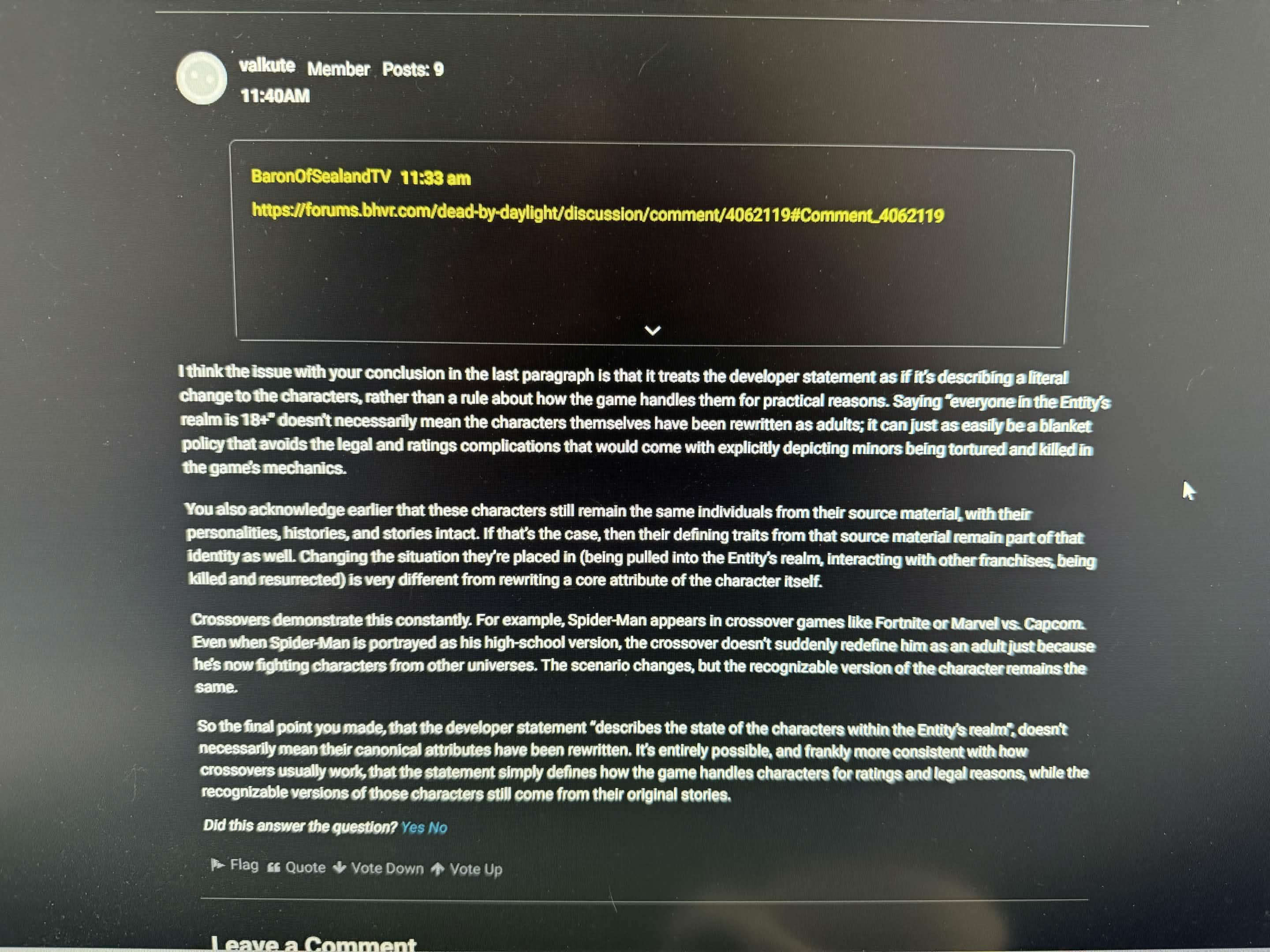
I think this reasoning still overlooks an important distinction. The Entity’s realm obviously places characters into a different scenario, but that doesn’t mean it creates an entirely new version of the character in the sense of rewriting their identity or source context. Crossovers like this still rely on recognizable versions of the characters from their original material, which is why they keep the same appearance, personality, and narrative point they’re drawn from.
The “everyone in the Entity’s realm is 18+” statement functions much more like a ratings/legal safeguard so the game can depict extreme violence without explicitly involving minors. It doesn’t actually override the source canon of licensed characters. If it did, developers could freely alter core traits like age, backstory, or identity whenever they crossed into another universe, which generally isn’t how licensed characters are handled.
So while the circumstances in the Entity’s realm are different (being hunted, resurrected, etc.), that doesn’t automatically mean the characters themselves become fundamentally separate versions with completely rewritten attributes. The statement about everyone being 18+ is better understood as a practical blanket for the game’s content rather than a literal retcon of the characters’ ages from their original stories.
0 -
I think the core issue here is that you’re treating the Dead by Daylight characters as if they must remain identical to their source-canon counterparts in every respect. But the premise of the Entity’s realm already establishes that this isn’t the case.
The characters in Dead by Daylight are not simply continuing the narrative of their original stories. They have been removed from their source universes and placed into an entirely different reality governed by the Entity. That alone creates a distinct version of the character.
For example, Steve Harrington in Stranger Things is not canonically trapped in a supernatural realm where he is repeatedly hunted and killed by killers from other franchises. That situation exists only within Dead by Daylight. The moment that scenario occurs, we are already dealing with a separate iteration of the character operating in a different continuity.
Because of that, changes in circumstances within the Entity’s realm do not need to override the source canon in order to be true within the game’s reality.
This is where the developer statement becomes important. When the developers say that everyone in the Entity’s realm is 18+, they are defining a property of the characters as they exist within that realm. Whether the motivation for the statement was legal, ratings-related, or narrative does not really change the outcome. The statement still describes the status of those characters in the game’s setting.
In other words, the source version of a character retains their original canon age. The Dead by Daylight version is a character placed into the Entity’s realm, which the developers have stated contains only adults.
So this is not a retcon of the original stories. It is simply acknowledging that the Entity’s realm already produces its own versions of characters, and those versions follow the rules established for that realm.
We already accept this kind of separation in other areas. The characters in Dead by Daylight experience events that never happen in their source material. They are killed repeatedly, resurrected, and interact with characters from completely unrelated franchises. That alone demonstrates that the DBD versions operate under their own continuity.
Given that, it seems entirely consistent to say that the DBD versions of the characters are adults, even if their source counterparts were younger at the point in their original stories that inspired their appearance.
So the developer statement does not need to overwrite the source canon. It simply describes the state of the characters within the Entity’s realm, which is ultimately the version of them that exists in Dead by Daylight.
0 -
I think the flaw in this reasoning is that you’re equating different circumstances with a completely different character identity. Yes, the Entity’s realm places characters into a different scenario and continuity, but that doesn’t suddenly detach them from the source material that defines who they are. Crossovers rely on recognizable versions of characters, their design, personality, and the era they come from are intentionally preserved so audiences know exactly which version is being represented.
The developer statement that everyone in the Entity’s realm is 18+ reads much more like a ratings or legal blanket so the game can depict violent mechanics like hooking and killing without the complications that would come with explicitly stating minors are involved. That kind of statement doesn’t actually rewrite the source canon those licensed characters originate from; it simply protects the game from those implications.
Changing the situation a character is in (being in the Entity’s realm, interacting with other franchises, being resurrected after death, etc.) isn’t the same thing as fundamentally rewriting the character themselves. Crossovers constantly place characters in new contexts without altering their original identity or the point in their story they represent.
What I’m also struggling to understand is why this point is being pushed so forcefully as if it has to be definitively settled in one direction. For something that should just be a simple lore interpretation, the amount of insistence on defending this specific conclusion makes it feel like there’s more motivating the argument than just a neutral discussion about canon. From the outside it starts to look less like a casual debate about game lore and more like an attempt to justify a particular position at all costs.
0 -
I think the point where we’re talking past each other is in how the situation created by the Entity’s realm is being interpreted.
You’re absolutely right that placing a character in a different scenario does not suddenly create a completely different character identity. Crossovers generally preserve recognizable versions of characters, and nothing I said requires those characters to stop being the same individuals from their source material. Their personalities, histories, and the stories they originate from can all still remain intact.
What I’m pointing out is simply that the moment those characters are placed into the Entity’s realm, they are operating within a different continuity governed by the rules of that setting. The characters in Dead by Daylight are interacting with people from entirely unrelated franchises, being killed and resurrected repeatedly, and participating in a cycle of trials that does not exist in their source material. None of that replaces their original canon, but it does mean the versions we see in the game are functioning within a different framework.
Because of that, characteristics defined by the rules of the realm can apply to those characters while they exist there without rewriting their source stories.
That’s why the developer statement matters. When the developers say that everyone in the Entity’s realm is 18+, the statement is describing a property of the realm itself. Whether the reason for that statement is legal, ratings-related, or narrative does not really change the fact that it still describes how the characters are treated within the setting of the game.
So this does not require rewriting the source canon of any licensed character. Their original stories remain exactly what they are. It only means that the versions of those characters that exist within the Entity’s realm operate under the rules that have been defined for that realm.
The reason I’ve been pushing this point is not because the issue has to be settled in one direction, but because the interpretation you’re suggesting seems to require treating the developer statement as something that does not actually describe the realm it refers to. I’m simply pointing out that there is a straightforward way to read that statement that allows both things to remain true at the same time: the source canon stays intact, and the rules of the Entity’s realm still apply to the versions of the characters who exist there.
0 -
Your last paragraph is where the reasoning becomes shaky. You say the developer statement provides a “straightforward way” for both things to be true, that the source canon stays intact while the realm’s rules apply to the characters there. But if the source canon truly remains intact, then the defining traits of those characters can’t simply be overridden by a rule of the setting without effectively altering the character being represented. That would go beyond changing the environment and would start changing the character themselves.
The distinction you’re drawing between the realm’s rules and the characters’ canon only works if those rules govern what happens to the characters, not what the characters fundamentally are. Being hunted, resurrected, or interacting with other franchises are situational mechanics of the realm. Age, however, is an inherent trait of the character as depicted in the source material. Treating a blanket developer statement as something that can redefine that trait essentially turns it into a retroactive modification of the character rather than just a rule of the setting.
In other words, the interpretation you’re proposing still ends up doing the very thing you say it doesn’t, it allows a gameplay-oriented rule to effectively redefine a core aspect of licensed characters while claiming their original canon remains untouched.
0 -
I think the distinction you’re drawing between a practical policy and a literal description of the characters is understandable, but I’m not sure it actually changes the issue being discussed.
You’re suggesting that the statement “everyone in the Entity’s realm is 18+” should be read purely as a ratings or legal safeguard rather than as something describing the characters themselves. That’s certainly possible in terms of the motivation behind the statement. But the statement itself is still framed as a description of the Entity’s realm.
That’s where I think the interpretation becomes important. If the developers say that everyone in the Entity’s realm is 18+, the most straightforward reading is that the characters who exist in that realm are adults within that setting. That doesn’t require rewriting the source canon or altering the characters’ identities in their original stories. It simply means the versions of those characters who appear within the Entity’s realm operate under the rules defined for that realm.
The crossover examples you mentioned don’t necessarily contradict that. In most crossover settings the characters still retain their recognizable identities while also operating under the rules of the world they’ve been placed into.
So the question I keep coming back to is fairly simple: if the developer statement that everyone in the Entity’s realm is 18+ isn’t describing the characters as they exist in that realm, what exactly is it describing?
0 -
I understand what you’re getting at here, but I think the argument is assuming a stronger claim than I’m actually making.
I’m not saying that the realm’s rules can arbitrarily rewrite any canonical attribute of a character while leaving everything else untouched. I’m saying that the moment a character is depicted in Dead by Daylight, we are dealing with that character as they exist within the Entity’s realm and under the constraints and rules the developers have defined for that setting.
That distinction matters because you’re treating “age” as an inherent trait that can never be treated differently without it becoming a retcon of the source material. But that doesn’t follow. A character can remain recognizably the same individual from their source material while still being presented under conditions that differ from their original story, without that implying their source canon has been rewritten.
This is essentially how crossovers and alternate-continuity settings work: the source canon remains intact, and the crossover depiction is governed by the rules and constraints of the crossover setting. In Dead by Daylight, those constraints are not just environmental. They include how characters are handled and presented in the realm, including what is permissible to depict.
So when the developers state that everyone in the Entity’s realm is 18+, I’m not claiming that this retroactively modifies the original canon age in the source material. I’m saying it defines how characters are treated within the Entity’s realm in Dead by Daylight, which is exactly the context being discussed.
You describe this as “effectively redefining a core aspect of the character,” but that assumes that a depiction of the character under the rules of another setting must be read as overriding the source. I don’t think that’s how these settings are usually interpreted. The source remains unchanged, and the crossover depiction follows the crossover’s rules.
Which brings me back to the same question, because your edited reply still doesn’t directly answer it. If the developer statement “everyone in the Entity’s realm is 18+” is not describing the characters as they exist within the Entity’s realm, what exactly is it describing?
(For anyone wondering, this is a screenshot of Valkute's original reply at this timestamp):
0 -
who cares it's a horror game. have you ever seen childs play?
0 -
That may be true, but the thread is about what BHVR has said. Is it still the official stance that everyone in the Entity’s realm is 18+?
2 -
I remember them getting really upset when people were calling Viktor a baby, but he literally is. We all feel the same about that "but he's 1,000 years old bro" reasoning right? 😵 Granted it's not that big of a deal since he's just a weird little set piece and nothing more. But if it's such an issue having minors as characters in the game, why add them at all to begin with? They're just creating problems for themselves.
0 -
I agree the Viktor debate shows how messy the optics can get, but I’m trying to stick to what BHVR has actually stated. Is it still their official position that everyone in the Entity’s realm is 18+? If there’s a newer statement contradicting that, I’d like to see it.
1 -
I think you'd only have success pestering them over reddit or the livestreams. And even then you're probably gonna be waiting. Genuinely, good luck to you though. It's not easy getting them to answer anything.
1 -
On that, I wholeheartedly agree XD. Thank you, I will do my best XD
1 -
Appreciate the discussion, but I think we’ve exhausted the interpretation side of it. Unless someone has a newer official BHVR statement contradicting the “everyone in the Entity’s realm is 18+” stance, I’m going to assume the last official word still stands.
1 -
Quentin's redesign was based on what the actor looked like at the time of said redesign, presumably because him asking for them to fix his face was the reason they did it at all. Idk how relevant it is but he technically isn't based physically on a teenager.
0