Hex Perks Need a Fundamental Rework - Statistical Analysis from Both Sides

The numbers don't lie: hex perks have become a liability in Dead by Daylight's current meta, with statistical evidence showing why the community has largely abandoned them despite their theoretical power. While hex perks were designed as high-risk, high-reward options, current data reveals they're more accurately described as high-risk, medium-reward due to fundamental totem spawn issues that persist years after the mechanic's introduction.
Usage rates reveal the meta reality
Current statistics paint a stark picture of hex perk viability. Only 15-20% of meta killer builds include hex perks, while 80-85% favor standard regression and tracking perks like Pain Resonance and Pop Goes the Weasel. This isn't preference—it's optimization based on reliability.
NightLight data shows Pain Resonance appearing in approximately 29% of matches compared to Hex: Ruin's estimated 5-8% usage rate. The mathematical reality is brutal: Pain Res + Pop combinations provide guaranteed regression of roughly 220% total generator progress across a match, while Ruin + Undying can deliver anywhere from 0% value (early cleanse) to game-winning impact—but averages significantly lower due to reliability issues.
Only three to four hex perks maintain A-tier status: NOED (endgame timing protection), Devour Hope (high mobility killer synergy), Plaything (multiple totem creation), and Undying (single-use protection). Every other hex perk ranks in C or D tiers according to community tier lists, with win rates typically 6-8% lower than their kill rates due to early cleansing.
Totem spawn system creates systematic failures
The community has documented extensive evidence of problematic totem spawns across multiple platforms, with Steam forums, Reddit r/deadbydaylight, and official BHVR forums showing consistent complaints. Average totem survival time ranges from 30-90 seconds, with many hexes cleansed within the first minute on maps with poor spawn locations.
Specific problem patterns emerge repeatedly in community reports:
Generator proximity spawns remain the most frequent complaint, with totems spawning "directly next to generators" on maps like Badham Preschool and The Game. Community members have documented totems literally 1 meter from generators on Eyrie of Crows, while Autohaven spawns totems "at a gen on a T L wall."
Survivor spawn adjacency creates instant failures, with players reporting spawning "right in front of lit hex totems" before the match effectively begins. "Lighthouse" spawns in open areas—particularly hill spawns visible across entire maps—have earned community nicknames like "beacon from Lord of the Rings" and "signal from Gondor."
Indoor maps like Lery's Memorial Institute and Midwich Elementary provide notably better totem concealment, while outdoor maps like Autohaven Wreckers and Coldwind Farm consistently generate community complaints about "beacons burning bright as all hell."
Developer statements vs. community reality
Behavior Interactive maintains their original "high-risk, high-reward" design philosophy established with Patch 1.3.0's introduction of hex perks alongside The Hag. Official patch notes claim improvements to totem hiding spots through "new interaction mechanics," but community feedback consistently highlights poor spawns as a core problem that persists across map updates.
Recent developer focus has shifted toward addressing the solo queue vs. SWF experience gap. Hex: Pentimento's major rework exemplifies this approach—the perk received significant nerfs including 16-meter aura reveals for survivors, reduced from 30% to 20% base repair reduction, with developers citing new player experience concerns from the FNAF chapter influx.
PTB feedback cycles show recurring complaints about totem spawn RNG, but fundamental system changes remain minimal. The Kill Switch system has been used for crisis management, but hasn't addressed structural hex perk issues.
Community sentiment spans both sides
Cross-platform analysis reveals overwhelmingly negative sentiment toward hex perk viability from both killer and survivor perspectives. Steam discussions titled "Hex totems are predictable and useless" and BHVR forum threads like "Hex totems are miserable" generate extensive community engagement.
Killer players report "dropping hexes for good" due to RNG dependency, with comments like "High risk, high reward not being met—it's high risk, low reward." Many describe hex perks creating "dead perk slots" within seconds of match start due to factors entirely outside player control.
Surprisingly, survivor players acknowledge the unfairness, with Steam community members stating "I feel bad for killers when I play survivor because hex totems are so damn easy to find." Multiple survivor players report leaving hex totems uncleansed "just so the killer can get some value."
Historical changes show diminishing viability
Hex perk nerfs have compounded reliability issues over time. Hex: Ruin's evolution demonstrates the trajectory: originally providing 200% regression, it was reduced to 100%. These power level reductions occurred without addressing underlying spawn issues.
The Pentimento rework reveals developer priorities: originally offering up to 30% repair reduction at 5 totems, it now provides 20% base reduction with scaling bonuses, plus survivor aura reveals within 16 meters of rekindled totems. Community reaction was mixed, with players noting "Penti was already bad, now it's just trash... Aura reveal is absurd."
Historical usage data shows clear meta evolution away from hex dependency. Pre-6.1 patch, Ruin + Undying was meta-defining. Current meta shows Pain Resonance maintaining 29% usage while Ruin has dropped to single-digit percentages.
Perk slot efficiency favors alternatives
Mechanical analysis reveals why competitive players avoid hex builds. Standard regression perks provide 3-4x more reliable value per perk slot than hex alternatives. Pain Res + Pop requires two slots but guarantees minimum value thresholds, while Ruin + Undying requires two slots but can provide zero value through early cleansing.
The opportunity cost calculation is stark: if a hex is cleansed within the first minute, players lose an entire perk slot for potentially the entire match. Non-hex builds consistently provide value in 90%+ of matches, while hex builds show extreme variance from game-winning impact to complete failure.
Community theorycrafting emphasizes predictable value over high-ceiling effects. Players choose controlled, token-based systems like Grim Embrace or time-limited effects like Pop over unlimited potential that depends on totem spawn RNG and survivor behavior.
Specific hex perk analysis reveals design issues
NOED and Devour Hope maintain usage because they circumvent early-game vulnerability. NOED activates when survivors focus on escapes rather than totem hunting, while Devour Hope rewards specific killer playstyles with game-changing potential. Both provide timing advantages that other hex perks lack.
Lower-tier hex perks fail for systematic reasons: Huntress Lullaby only affects newer players, Third Seal's blindness has minimal impact against experienced survivors, and Ruin's post-nerf power level doesn't justify the risk of instant removal.
The pattern is clear: hex perks that avoid early-game vulnerability succeed, while those depending on early-game value consistently underperform due to spawn issues.
Recent patches show minimal hex focus
2024-2025 patches have largely ignored hex perk issues in favor of broader balance changes. Patch 8.2.0 focused on killer power adjustments (Dredge, Doctor, Nemesis) without addressing totem mechanics. Patch 8.3.0 introduced Hex: Crowd Control changes but maintained the problematic spawn system.
Developer priorities have shifted toward quality-of-life improvements, map reworks, and new game modes rather than fundamental hex perk system updates. The FOV slider addition and generator damage modifications received more attention than longstanding totem spawn complaints.
Statistical evidence supports community frustration
Totem survival statistics validate community concerns: 14-second base cleansing time becomes 30-90 seconds average survival when accounting for spawn quality and survivor knowledge. High MMR matches show even shorter survival times as experienced survivors memorize all spawn locations.
The all-or-nothing nature creates unacceptable variance for competitive play. While hex perks theoretically offer unlimited potential, their practical application suffers from structural reliability problems that make them inefficient uses of limited perk slots.
Conclusion: systematic failure requires systematic solutions
The evidence overwhelmingly demonstrates that hex perks are underpowered not due to number tuning, but due to fundamental system design flaws. Totem spawn RNG, survivor knowledge accumulation, and 14-second cleansing time create a perfect storm that makes hex perks unreliable for competitive play.
Community-proposed solutions include spawn immunity periods, distance requirements from generators, killer placement control, or delayed visual effects. Without addressing these structural issues, hex perks will remain niche options rather than viable meta choices, regardless of their theoretical power levels.
The data supports what the community has long maintained: hex perks need systematic rework, not incremental balance adjustments. Until totem mechanics receive fundamental changes, reliable regression and tracking perks will continue dominating the meta while hex perks remain high-variance gambles unsuitable for consistent competitive play.
Comments
-
There's also the bit where literally all boon totem placements are in out of the way concealed locations.
0 -
Hex totems are just hard to balance so they're fair for both sides. Killers are already getting value for doing nothing. Should they be getting even more value while making it harder to find totems? And I don't wanna coddle survivors, but certain hexes like Devour Hope and NOED are so oppressive that totems kinda need to be easy to find.
8 -
im 80% sure noed is coded to appear near survivors, it literally happens all the time
-1 -
In October of 2017, a few days after Freddy's release, one of my favorite DBD content creators from back in the day made a video where he was going for a 4-man Devour Hope. And, in that video, he says that finding Totems "is like playing Where's Waldo, with Waldo standing in a white room by himself".
And in the current DBD…
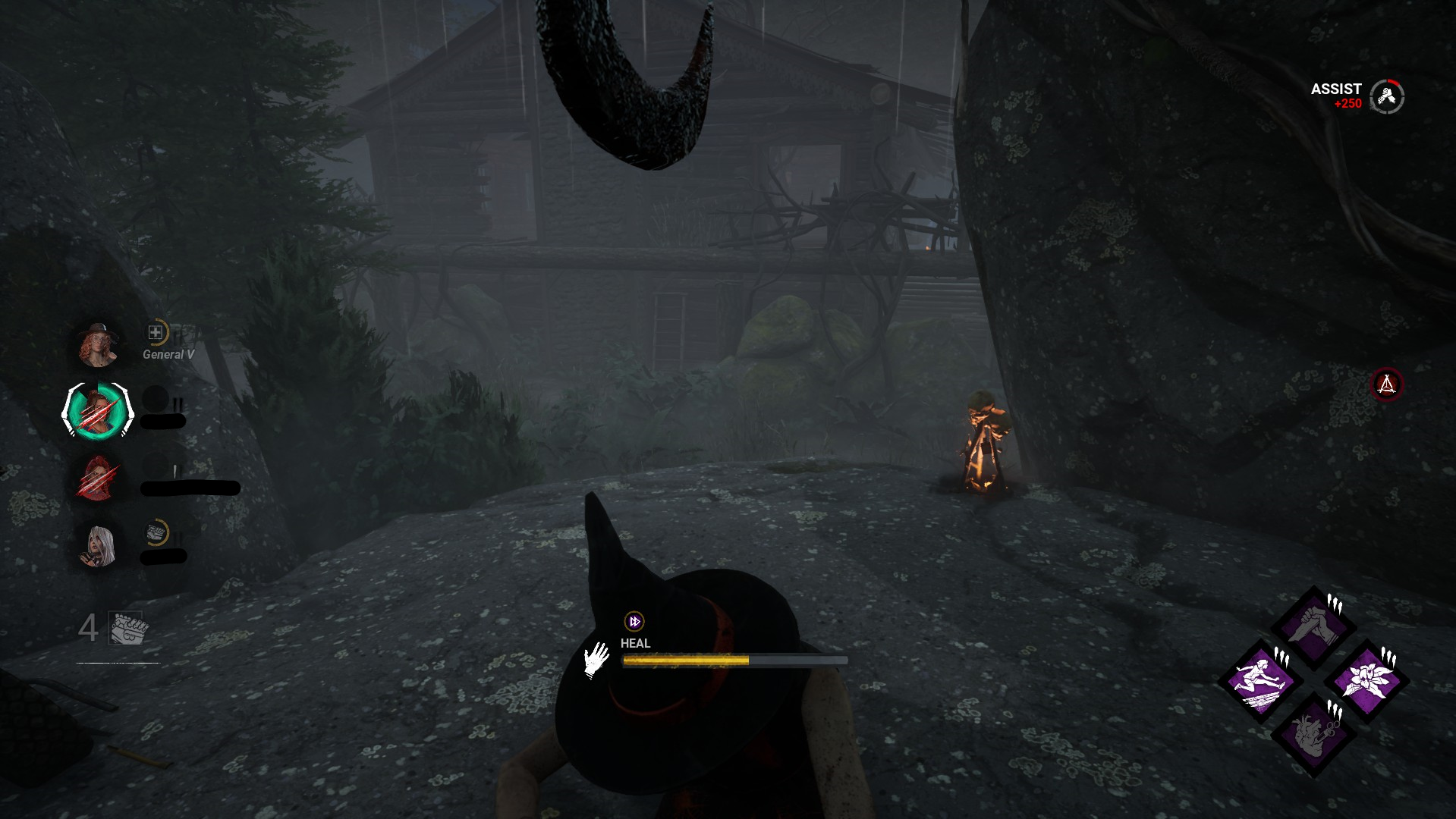
The situation still hasn't changed.
3 -
The purpose of the killer is to be powerful
-8 -
Impressive. I could never write a college essay on hex totems.
4 -
I appreciate that you care about Hexes so much. But this whole post's TLDR is "Hexes aren't worth it"
Which, yes, they aren't.
There are 3 things that can be done:
- A basekit mechanic that conceals Hexes for some time at the start (best until they actually activate)
- Buff all of the weaker Hexes (Ruin, Huntress Lullaby, Two Can Play, Pentimento, Wreched Fate)
- Fix totem spawns
Until at least one of these is done, only Haunted Grounds are worth running because they are guaranteed value.
1 -
Hex totems also need to be considered for their time penalties incurred on survivors. Even if it is easy to see, it still takes time to cleanse it. Undying doubles the time investment. From a survivor perspective, if I see a team mate cleansing a totem and it's NOT a hex, I feel like the 20 seconds lost might cost the game. It can't be both an game ending blunder and barely viable just because it is either a dull totem or hex totem when it was cleansed.
Does it feel bad when devour gets cleansed straight away, sure. But when that was going to be part of my strategy, i spend a little time defending that totem. And when its cleansed anyway, generally after the first instadown. It still provided a bunch of help before it was cleansed.
That being said, I think the preferable design fix would be to WEAKEN the hex affect, but provide a sort of consolation prize for after its gone. Take ruin, decent hex affect maybe the hex affect doesn't even need to be weaker to give it a 5% global genny slowdown once cleansed. IN this way the matches wouldn't so "swingy" based on a good totem spawn vs bad.
-1 -
Love the chat gpt write up about hex totems but like maybe just say a killer can move his hex to a new totem if he finds one with like the same speed a boon totem needs to place.
-2 -
I didn't use ChatGPT bro…
-2 -
Only 15-20% of meta killer builds include hex perksGiven only 12.7% of killer perks are hex perks, that's pretty good.
Cross-platform analysis revealsBut there's no 'analysis'. We get lots of 'sciency' terms scattered throughout as if the post was a doctoral study. Some people have an opinion is not an analysis.
The Kill Switch system has been used for crisis management, but hasn't addressed structural hex perk issues.This is one of those AI sounding things. The Kill Switch, very obviously, has nothing to do with hexes. But its the type of thing an AI writing assistant throws in because its trying to fill its word count.
0 -
I'm just saying that Hex Perks suck ass right now.
-1 -
You had ai write this.
0 -
Either way, it's not really wrong. Hex totem placements are absolutely atrocious and they need to be revamped. If the devs are very concerned with taking excessive RNG out of the game, they have to address this. Tweaking numbers and percentages doesn't change this.
Devour Hope and NOED also continue to be problematic. If devour isn't luckily found early in the match, then it gets the killer more free downs and easily wins them the game.
It's really the same thing for NOED. What seemed to be a somewhat easy game suddenly turns into a struggle at end game. The anti-camp meter no longer works, and if that one survivor is "unskilled" enough to have been instadowned right next to the totem, they are SOL because the killer can simply camp both. Unless the survivors find and cleanse that totem, no one can get the save. The whole team also needs to be reset and have a gate already opened, or that one survivor on the hook (or someone else) is still guaranteed to not escape. In closer games where one or two survivors have already died and the others may be injured, it pretty much guarantees the three kills.
1 -
Yeah, and I hate when I bring a Hex Perk and it's immediately gone a minute into the match…
0 -
Yes, I used AI to help structure this post. I have trouble organizing my thoughts into coherent writing, so I used it as an assistive tool to present my research and analysis clearly. The data, conclusions, and gameplay insights are all mine based on my experience - AI just helped with organization and formatting since that's a field I struggle in. Feel free to downvote me instead of actually engaging with the problem because 'AI Bad!'
-2 -
Doing nothing? Nearly every hex requires you to do stuff on top of the hex existing. Usually for mediocre effects.
1